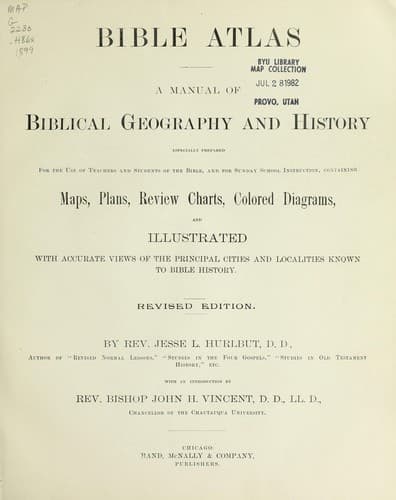
Bible Atlas: A Manual of Biblical Geography and HistoryHurlbut, Jesse Lyman
Religion
Bible Atlas: A Manual of Biblical Geography and History
Hurlbut, Jesse Lyman
Bible -- Geography; Bible -- Geography -- Maps; Bible -- History of Biblical events
THE history of the Bible is so interwoven with that of the East, that a
view of its great empires is necessary. All the lands between the
Persian Gulf and the Mediterranean were united at different periods
under one government, and formed an empire which was constantly changing
according to the power or weakness of its dominant state; for in the
Oriental world there never has existed anything like a confederation of
states on an equality. At different periods Ur, Babylon or Nineveh
conquered all the surrounding lands; or at other periods a single race,
as the Medes and Persians, obtained supremacy. The empire thus arose and
fell, to be succeeded by a similar empire with another centre. During
the Old Testament history, between the days of Abraham and of Ezra, more
than 1,500 years, four successive empires appeared in the East. These
were:
I. The Early Babylonian Empire. B.C. 2280-1120.
II. The Assyrian Empire. B.C. 1120-626.
III. The Babylonian Empire. B.C. 606-538.
IV. The Persian Empire. B.C. 538-330.
I. =The Early Babylonian Empire= began about 3000 B.C., with several
states, each having a city as its capital. Among these were Ur
(_Mugheir_), Lagesh (Shirpurta), and Isin. These separate kingdoms were
united in an empire, of which Babylon was the capital, in the reign of
Hammurabi (the Amraphel of Gen. 14:1), about 2280 B.C. It lasted, with
varying fortunes, for 1,000 years. A map of this empire, in the time of
Abraham, is given on page 34.
[Illustration: AN ASSYRIAN PALACE.]
Public-domain text, read in full here on John Shaqi.
Reviews
Reviews
No reviews yet
Be the first to share your thoughts on this work.
Elsewhere in the archive
Join the Discussion
Join the discussion
Sign in to leave a comment or review.
Sign InorCreate an account