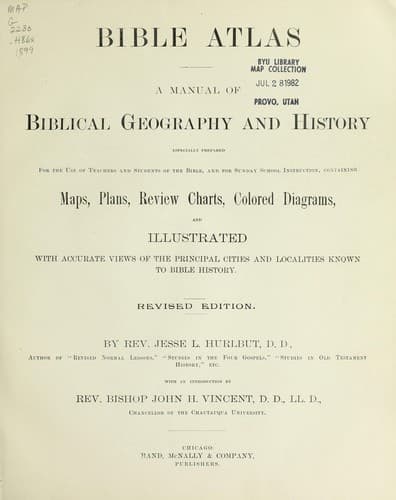
Bible Atlas: A Manual of Biblical Geography and HistoryHurlbut, Jesse Lyman
Religion
Bible Atlas: A Manual of Biblical Geography and History
Hurlbut, Jesse Lyman
Bible -- Geography; Bible -- Geography -- Maps; Bible -- History of Biblical events
III. =The Babylonian Empire=, B.C. 606-538. This period has been more
correctly termed that of the "four kingdoms," since the East was not
then, as during the Assyrian period, under one government. The
destruction of Nineveh had been wrought by the union of the Medes and
Babylonians, under their kings, Cyaxares and Nabopolassar, and these
peoples succeeded to most, but not all, of the conquests of Assyria.
1. Media won its own independence, and obtained possession of Armenia,
Assyria Proper (north of the Tigris), and Elam. Persia had already been
conquered, so that the largest, though less important, portion of the
Assyrian empire now belonged to Media.
2. Babylonia obtained Chaldea, Mesopotamia, Syria and Palestine. Most of
these countries had claimed their independence on the fall of Assyria;
and their conquest occupied the reign of Nabopolassar, and his greater
son, Nebuchadnezzar. Thus the important parts of the Bible world were
nearly all under the rule of Babylon.
3. A new kingdom arose in Asia Minor, that of Lydia, embracing all the
lands between the Ægean Sea and the river Halys; destined, however, to a
short history, for it formed one of the earliest conquests of Cyrus the
Great.
4. Cilicia also appears for the first time upon the map, being situated
between the Euphrates and Lydia, north of Syria, and south of the Halys
river, and retained its independence until the close of the Babylonian
period, when it was annexed to Persia, though even then it retained its
own kings.
5. To these might be added Egypt, though outside of the Asiatic world.
It soon shook off the yoke of Assyria, and resumed its independence;
but, endeavoring to contest with Babylon the empire of the East, was
defeated at Carchemish by Nebuchadnezzar, and compelled to retire from
Asia. Some suppose that it was conquered by Babylon; and it is possible
that for a few years Egypt may have recognized the supremacy of
Nebuchadnezzar by paying tribute, but it was never a part of his empire.
[Illustration: BLACK OBELISK.]
Public-domain text, read in full here on John Shaqi.
Reviews
Reviews
No reviews yet
Be the first to share your thoughts on this work.
Elsewhere in the archive
Join the Discussion
Join the discussion
Sign in to leave a comment or review.
Sign InorCreate an account