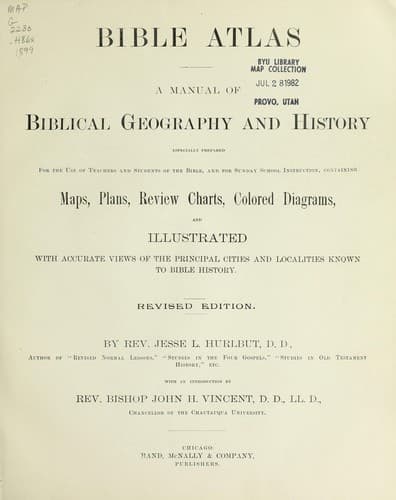
Bible Atlas: A Manual of Biblical Geography and HistoryHurlbut, Jesse Lyman
Religion
Bible Atlas: A Manual of Biblical Geography and History
Hurlbut, Jesse Lyman
Bible -- Geography; Bible -- Geography -- Maps; Bible -- History of Biblical events
11. But they preferred to return by the same route, perilous as the
journey was from the enmities excited by their preaching; and revisited
Lystra, Iconium and Antioch, confirming the churches which they had
planted, and establishing new ones in other neighboring places in
Pisidia and Pamphylia, as in _Attalia_, a seaport on the river
Katarrhaktes, 16 miles from Perga, now known as _Adalia_, where they
took ship once more, and thence sailed over the Cilician section of the
Mediterranean, north of Cyprus, to Antioch in Syria, where they were
gladly received by the church which had sent them forth.
OUTLINE FOR TEACHING AND REVIEW.
1. Draw on the blackboard the subjoined Review Chart of Asia Minor, and
let the class also draw the same on slates or paper, in a rough sketch.
Then insert the provinces, and drill the class upon their names,
reviewing from the beginning after each group is given.
_Black Sea._ Pontus, Paphlagonia, Bithynia.
_Ægean Sea._ Mysia, Lydia, Caria.
_Mediterranean Sea._ Lycia, Pamphylia, Cilicia.
_Interior._ Galatia, Cappadocia, Lycaonia, Pisidia, Phrygia.
2. Draw in colored chalk the line representing _Paul's travel_, calling
attention to the places and events; and frequently review the list, as a
new name is presented. (1.) Antioch in Syria. (2.) Seleucia. (3.) Island
of Cyprus. (4.) Salamis. (5.) Paphos. (6.) Perga. (7.) Antioch in
Pisidia. (8.) Iconium. (9.) Lystra. (10.) Derbe. (11.) Return, and
Attalia.
THE SECOND MISSIONARY JOURNEY.
The map presents the field of the apostle Paul's labor during four of
the most active years of his life, according to Alford's chronology,
from A.D. 50 to 54. To this period belong two journeys: a journey from
Antioch to Jerusalem and return, and the second missionary journey,
through Asia Minor, Macedonia and Greece.
[Illustration: PAUL'S SECOND MISSIONARY JOURNEY.]
The journey to Jerusalem, not indicated upon the map, was Paul's third
visit to that city after his conversion. His first visit was in A.D. 40,
when Barnabas introduced him to Peter and James (Acts 9:26-30); his
second was in A.D. 45, when with Barnabas he brought the gifts of the
church at Antioch (Acts 11:30); his third was in A.D. 50, when, again
accompanied by Barnabas, he attended the council in Jerusalem, called to
establish the principle upon which Gentiles were to be received into the
Christian church. (Acts 15:1-30.)
The second missionary journey began with an unfortunate disagreement
between Paul and Barnabas, which resulted in their separation, Barnabas
going to the island of Cyprus, and Paul to the mainland. (Acts
15:36-40.) The apostle chose as his companion Silas, or Silvanus, and
was afterward joined by Timothy, and Luke, the author of the third
Gospel and the Acts. We may subdivide this journey into three sections,
as follows:
I. The Stations in Asia, seven in number.
II. The Stations in Europe, eight in number.
III. The Stations of the Return, four in number.
Public-domain text, read in full here on John Shaqi.
Reviews
Reviews
No reviews yet
Be the first to share your thoughts on this work.
Elsewhere in the archive
Join the Discussion
Join the discussion
Sign in to leave a comment or review.
Sign InorCreate an account