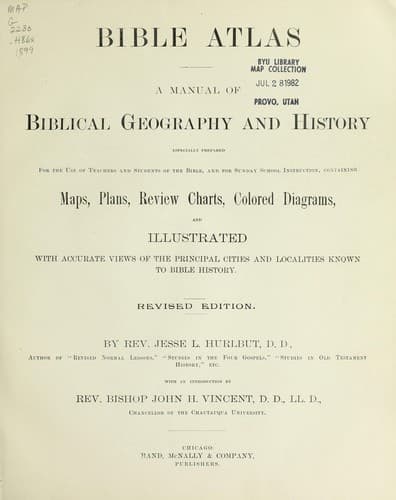
Bible Atlas: A Manual of Biblical Geography and HistoryHurlbut, Jesse Lyman
Religion
Bible Atlas: A Manual of Biblical Geography and History
Hurlbut, Jesse Lyman
Bible -- Geography; Bible -- Geography -- Maps; Bible -- History of Biblical events
The apostle Paul and his companions sailed across the Ægean Sea from
Troas, in a northwesterly direction, passing the storied isles of
Tenedos and Imbros; anchored for the first night off Samothracia, "the
Thracian Samos," a rocky island near the coast of Thrace; and the next
day passed northward of Thasos, and anchored in the harbor of Neapolis,
on the border of Thrace. They did not remain at the seaport, but pressed
inland to the larger city, which was to be memorable as the first
foothold of the gospel in Europe. In the European part of the second
missionary journey we notice eight places visited by the apostle.
1. _Philippi_ (Acts 16:12-40). This was an ancient town, enlarged and
renamed by Philip, the father of Alexander the Great. Near it was fought
the great battle between Augustus and Antony on one side, and Brutus and
Cassius on the other, in which the hope of a Roman republic perished,
and the empire was ushered in. It had been made a _colony_; that is, a
branch of Rome itself, and enjoyed certain privileges of
self-government, so that its magistrates bore Roman titles, as noticed
by Luke. Here Lydia, the first convert in Europe, was baptized, and a
church was planted; Paul and Silas were scourged and imprisoned, and set
free by divine power; the jailer was brought to Christ; and the
officials of the city were made to tremble at having inflicted violence
upon citizens of Rome.
2. _Amphipolis_ was 33 miles southwest of Philippi, and 3 miles from the
Ægean Sea. It was a town of ancient fame; but, in Paul's time, decayed
in population; and, having no synagogue or Jewish population, was not
yet made a field of his labors. After a delay of only a day, he
journeyed on still further westward. (Acts 17:1.)
3. _Apollonia_ was 30 miles from Amphipolis, and an important city; but
for some reason Paul did not choose to labor in its vicinity, and
remained there but a day. (Acts 17:1.)
4. _Thessalonica_ (Acts 17:1-9) was the capital of the entire province,
and 40 miles from the preceding station. It was named after a sister of
Alexander the Great, and had many historic associations. An arch is
still standing, and was doubtless seen by the apostle, which
commemorated the victory at Philippi. There was a large Jewish
population, and a synagogue, in which Paul preached for three sabbaths.
He succeeded in founding a church, mostly of Gentiles, to which he soon
after wrote his two earliest epistles, First and Second Thessalonians.
But the Jews excited a riot, and the apostles were compelled to leave
the city by night. Thessalonica, now called _Saloniki_, is still the
second city of European Turkey, and contains 80,000 inhabitants.
Public-domain text, read in full here on John Shaqi.
Reviews
Reviews
No reviews yet
Be the first to share your thoughts on this work.
Elsewhere in the archive
Join the Discussion
Join the discussion
Sign in to leave a comment or review.
Sign InorCreate an account