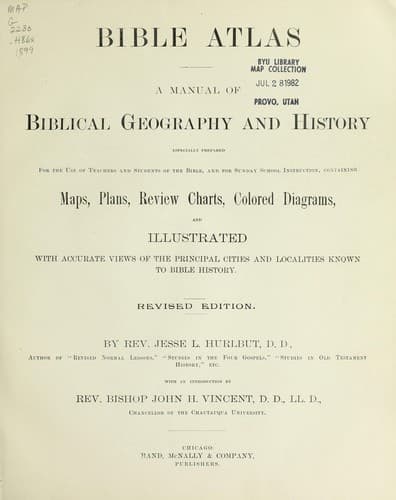
Bible Atlas: A Manual of Biblical Geography and HistoryHurlbut, Jesse Lyman
Religion
Bible Atlas: A Manual of Biblical Geography and History
Hurlbut, Jesse Lyman
Bible -- Geography; Bible -- Geography -- Maps; Bible -- History of Biblical events
7. From Ephesus he may have set sail once more as a prisoner for _Rome_.
He was accompanied by several friends, as Titus, who had left Crete once
more to follow him; Luke the physician, his companion to the last; and
Tychicus. We know nothing concerning the voyage, and therefore represent
it on the map by the most direct route from Ephesus. At Rome we know
only that his imprisonment was short; that his friends were few, for the
church had been scattered by the terrible persecution of Nero; that Paul
was left alone at his first hearing, his friends having gone in various
directions, some on errands of duty, and others in fear of the world;
that he wrote earnestly to Timothy to come, bringing Mark with him (2
Tim. 4:9, 11); and we infer from his own expectations and the tradition
of the church, that his martyrdom was not long delayed.
The traditional place of his execution is shown at Aquæ Salvæ, now _Tre
Fontane_, three miles from Rome, near the road to Ostia.
OUTLINE FOR REVIEW.
1. Colosse and Ephesus. 2. Macedonia. (Philippi,
Thessalonica, Berea, Corinth.) 3. Crete. 4.
Nicopolis. 5. Troas. (Arrest?) 6. Ephesus. 7.
Rome. (Martyrdom.)
[Illustration: THE ISLES OF GREECE AND THE SEVEN CHURCHES.]
THE ISLES OF GREECE AND THE SEVEN CHURCHES.
I. AS THE islands of the Ægean Sea are often referred to in the Acts,
especially in the account of Paul's voyage to Phoenicia, in his third
missionary journey, we present a map representing them upon a larger
scale, with those portions of Asia and Europe adjoining them. Such of
the islands as are mentioned in the history have been already described.
One of the smallest is brought to our notice in the book of Revelation,
=Patmos=, to which the apostle John was banished. This lies 20 miles
south of the island of Samos, 24 miles west of Asia Minor, and about 70
miles southwest of Ephesus. It is about 20 miles in circumference, and
is rocky and barren. Its loneliness and seclusion made it a suitable
place for the banishment of criminals; and to it the apostle John was
banished by the emperor Domitian, near the close of the first Christian
century: though some scholars give an earlier date, under the emperor
Nero. A narrow isthmus divides the island into two parts, north and
south. On a hill in the southern part is a monastery named after the
apostle John, and near it is the cave where it is said by tradition that
he received the vision of the Apocalypse. In the Middle Ages the island
was called Patmosa, and it is now known as _Patmo_.
Public-domain text, read in full here on John Shaqi.
Reviews
Reviews
No reviews yet
Be the first to share your thoughts on this work.
Elsewhere in the archive
Join the Discussion
Join the discussion
Sign in to leave a comment or review.
Sign InorCreate an account