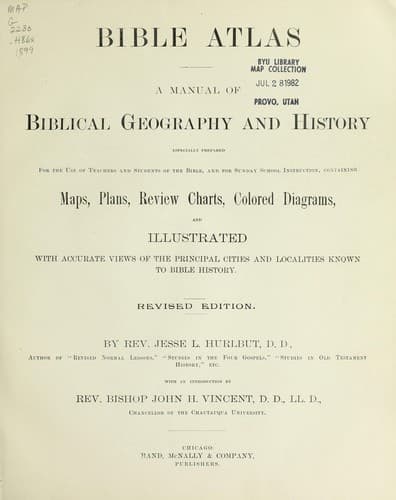
Bible Atlas: A Manual of Biblical Geography and HistoryHurlbut, Jesse Lyman
Religion
Bible Atlas: A Manual of Biblical Geography and History
Hurlbut, Jesse Lyman
Bible -- Geography; Bible -- Geography -- Maps; Bible -- History of Biblical events
There were three successive Temples. 1. _Solomon's Temple_ dedicated
about 950 B.C. The accounts of this building are so meager, and the text
is so uncertain, that it is impossible to construct its plan with any
satisfaction. A conjectural ground plan is given on page 71. This temple
stood until 587 B.C., when it was destroyed by Nebuchadnezzar. 2. After
a period of desolation of 50 years, _Zerubbabel's Temple_ was begun, 536
B.C., and finished 20 years after. Still less is known of its
architecture; but it was probably on the same general plan as Solomon's,
though less magnificent. It passed through many sieges, was desecrated
by enemies, and reconsecrated by the Jews, but stood until 30 years
before the birth of Christ. 3. _Herod's Temple_ was a restoration,
enlargement, and improvement upon Zerubbabel's. It was built by Herod
the Great, in sections, taking down the old and building the new part by
part, so that it occupied many years, and was not completed until after
Herod's death, and less than ten years before its final destruction.
This was the Temple standing in the time of Christ, and referred to in
the allusions of the New Testament. It was destroyed by the Romans under
Titus, A.D. 70, and was never rebuilt by the Jews, though its
restoration was more than once attempted. Its site is now occupied by
the Mohammedan "Dome of the Rock," often, but erroneously, called the
Mosque of Omar.
[Illustration: THE DOME OF THE ROCK.]
The Temple of Herod is the one usually described in works on the
subject. The authorities are: 1. The Scriptures, from which we gather
references to this Temple, and analogies from the description of the
Tabernacle, of which the Temple was an enlarged copy. 2. The description
given by Josephus, which was written 20 years after its fall, and gives
general impressions rather than accurate details. 3. The tract Middoth
"measures," in the Talmud, which gives precise measurements, but not
complete information. 4. The allusions in ancient Jewish literature, of
more or less value and authority. 5. The results of recent explorations
under the Temple area, which are very valuable. Different investigators
have come to very different conclusions concerning the Temple and its
courts. We present in this description those of Dr. James Strong, in
McClintock & Strong's Cyclopedia, from which our diagram is taken, by
permission. From the uncertainty of many dimensions, and especially the
difference of opinion with regard to the length of the Jewish cubit, in
which all the ancient measurements are given, most of our figures must
be regarded as general estimates, rather than precise statements.
The Temple consisted of a building called "the House of God," surrounded
by a number of open courts, the outer ones including the inner. On the
north of it was the Tower of Antonia; east, Valley of the Kedron;
south, Ophel; west, Valley of the Tyropoeon; and beyond, Mount Zion.
Public-domain text, read in full here on John Shaqi.
Reviews
Reviews
No reviews yet
Be the first to share your thoughts on this work.
Elsewhere in the archive
Join the Discussion
Join the discussion
Sign in to leave a comment or review.
Sign InorCreate an account