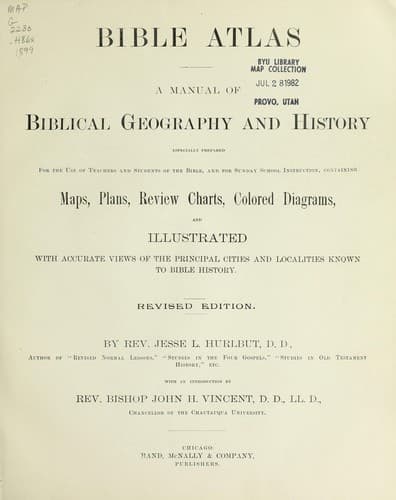
Bible Atlas: A Manual of Biblical Geography and HistoryHurlbut, Jesse Lyman
Religion
Bible Atlas: A Manual of Biblical Geography and History
Hurlbut, Jesse Lyman
Bible -- Geography; Bible -- Geography -- Maps; Bible -- History of Biblical events
IV. =The Court of Israel=, or Court of the Men, occupied the western end
of the Sacred Enclosure, and was a narrow corridor surrounding the Court
of the Priests. It was 10 feet higher than the Court of the Women; 320
feet east and west, by 240 north and south. The width of the corridor on
the north and south was 16 feet, and on the east and west 24 feet. It
was the place where the men of Israel stood to view the sacrifices. On
the outside of it rose the high inner wall of the Sacred Enclosure; on
the inside, a low balustrade sufficed to separate it from the space set
apart for the priests. Three gates led up to it on the north; as many on
the south; and one, the Gate of Nicanor, on the east. In the wall on the
north were chambers used severally for treasuries, guard, the storage of
salt, the storage of hides and of earthenware. On the south, at its
eastern corner, was the session-room of the Sanhedrim, called the Hall
Gazith, and beyond it rooms in the wall for guard, storage, etc. In the
Hall Gazith, the elders sat on seats of stone arranged in semicircular
form. [Review. 1. Name. 2. Location. 3. Dimensions. 4. Purpose. 5.
Walls. 6. Gates. 7. Rooms.]
V. =The Court of the Priests= was a raised platform within the Court of
Israel, and standing 3 feet above it. It was about 275 feet long, by 200
feet wide. It was mainly occupied by the House of God, in front of which
stood the great Altar of Burnt Offering, built upon the stone which now
rises under the Dome of the Rock. The altar was a rude structure of
rough stone, whitewashed, and 15 feet high. From its southwestern corner
an underground drain passed beneath all the courts to the brook Kedron.
Opposite, also, to the southwestern corner, was the Laver, supplying
water for the services and washings. Around the altar were marble tables
for various uses in the sacrifices, and in the pavement were rings for
securing the animals to be slain. [Review. 1. Name. 2. Dimensions. 3.
Altar. 4. Drain. 5. Laver. 6. Tables, rings, etc.]
Public-domain text, read in full here on John Shaqi.
Reviews
Reviews
No reviews yet
Be the first to share your thoughts on this work.
Elsewhere in the archive
Join the Discussion
Join the discussion
Sign in to leave a comment or review.
Sign InorCreate an account