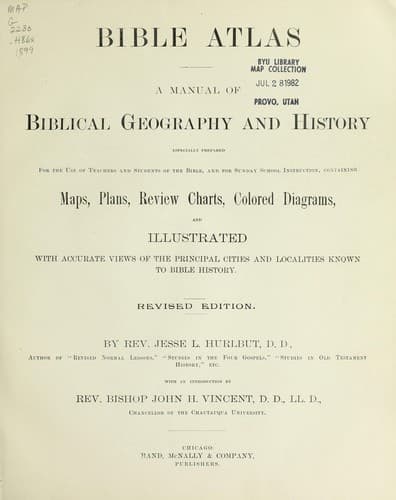
Bible Atlas: A Manual of Biblical Geography and History — John Shaqi
Bible Atlas: A Manual of Biblical Geography and HistoryHurlbut, Jesse Lyman
Religion
Bible Atlas: A Manual of Biblical Geography and History
Hurlbut, Jesse Lyman
Bible -- Geography; Bible -- Geography -- Maps; Bible -- History of Biblical events
5. =Tubal=, and 6. =Meshech=, are generally associated in Scripture.
(Ezek. 27:13; 32:26; 38:2, 3; 39:1.) From their associations, they are
to be sought near the Caspian and Black Seas, where Herodotus mentions
the _Tibareni_ and the _Moschi_.
7. =Tiras= (1. Chron. 1:5) was believed by the Jews to refer to the
_Thracians_, southwest of the Black Sea. There is nothing to oppose this
view, but no evidence except the similarity of name in its favor.
II. THE HAMITIC RACES.
These are named with greater particularity, because they were those
which rose to prominence early in the history, and those with which the
Hebrews were brought into closer relations, either as enemies or as
friends. Four principal races are given, some of which were greatly
subdivided. The homes of these races were in Africa, Eastern Arabia,
with a fringe of sea-coast along the eastern Mediterranean, and the
great Mesopotamian valley, in which arose the earliest world empires.
They have been sometimes called _Turanians_. It is by no means probable
that all these nations should be regarded as the descendants of Ham, the
son of Noah. In this list are evidently grouped together some races
whose territory was contiguous, but whose physical appearance and
language show no relationship.
1. =Cush= is, throughout the Bible, the word translated _Ethiopia_.
Generally this refers to the region south of Egypt, now known as
Abyssinia; but in Gen. 2:13, Isa. 11:11, and Ezek. 38:5, the reference
must be to an Asiatic Cush, in Mesopotamia. The subdivisions of the
Cushite tribes in Gen. 10:7-12, show that the earliest great Oriental
monarchies were of this race. These subdivisions are as follows:
(1.) _Seba._ These were, probably, the Ethiopians of Meroë, on the Nile,
anciently called _Saba_; in Isa. 43:3 and 45:14, connected with the
Egyptians.
(2.) _Havilah._ This is supposed to refer to _Arabia_, or at least a
part of it.
(3.) _Sabtah._ This may refer to the _Sabbatha_, or _Sabota_, of Pliny
and Ptolemy, on the southern shore of Arabia.
(4.) _Raamah_, with whom are associated his sons or descendants, _Sheba_
and _Dedan_, occupied the eastern shore of Arabia, near the Persian
Gulf.
(5.) _Sabtechah._ This is unknown, but, from the relation of the
previous names, may have been in the southeastern portion of Arabia.
(6.) _Nimrod_ is named as a descendant of Cush (perhaps the only name of
an individual in the list), and the founder of the early Babylonian
empire.
2. =Mizraim= is the name everywhere used for _Egypt_ in the Hebrew. The
word is in the dual form, representing the two divisions of the country,
and corresponding to the two crowns on all the royal effigies. Several
branches of this race are especially mentioned.
(1.) _Ludim._ Not the same with the _Lud_ of verse 22, but from its
associations plainly in Africa. The location has been given as _Nubia_,
but is very doubtful.
(2.) _Anamim._ An unknown people, whose identity was early lost in some
other race.
Public-domain text, read in full here on John Shaqi.
Reviews
Reviews
No reviews yet
Be the first to share your thoughts on this work.
Join the Discussion
Join the discussion
Sign in to leave a comment or review.
Sign InorCreate an account