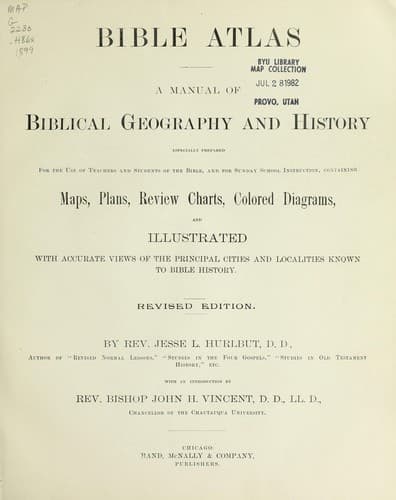
Bible Atlas: A Manual of Biblical Geography and HistoryHurlbut, Jesse Lyman
Religion
Bible Atlas: A Manual of Biblical Geography and History
Hurlbut, Jesse Lyman
Bible -- Geography; Bible -- Geography -- Maps; Bible -- History of Biblical events
(3.) _Lehabim._ These are elsewhere in Scripture called _Lubim_, and
were the Libyans, or people of Libya, west of Egypt, on the southern
shore of the Mediterranean.
(4.) _Naphtuhim._ Probably the _Na-Ptah_ of the Egyptian monuments,
having their home at _Memphis_, south of the Delta.
(5.) _Pathrusim._ Often referred to in the prophets as _Pathros_, or
Upper Egypt.
(6.) _Casluhim._ An unknown people, perhaps in the vicinity of _Goshen_.
(7.) _Caphtorim._ Generally supposed to refer to the people on the
island of _Crete_. With these, and not with the _Casluhim_, should the
_Philistim_ be connected. (See Deut. 2:23, Jer. 47:4, Amos 9:7.)
3. =Phut.= The word is several times translated _Libya_, and, from its
association with other tribes, should probably be referred to that
section in Northern Africa. (See Jer. 46:9; Ezek. 27:10; 30:5; 38:5;
Nah. 3:9.) Some of these passages would indicate that there was also an
Asiatic branch of this same family.
4. =Canaan.= The ancient inhabitants of Palestine and Lower Syria, from
Gaza to Hamath. In their most flourishing period, just before the
conquest by Joshua, they embraced six subdivisions or clans. (See map on
page 36, and explanations.)
III. THE SEMITIC RACES. (Gen. 10:21-31.)
The descendants of Shem are placed last in the list of the table of
nations, not because their founder was the youngest, but because out of
their lines one family is chosen as the especial theme of the history,
which thus receives a fitting introduction. Shem was the founder of five
great races, and of many subordinate tribes.
1. =Elam= everywhere is recognized as the name of a province east of the
Tigris and north of the Persian Gulf, called by the Greeks _Elymais_.
The name was often applied, in later times, to the whole of Persia,
whose capital stood within its territory.
2. =Asshur= is frequently mentioned in the Old Testament. It was located
on the Tigris, having Nineveh as its capital, and its people at one time
were rulers of all the lands westward to the Mediterranean.
3. =Arphaxad=, or _Arpachshad_ (as in the margin of Gen. 11:10), has
been supposed to be the ancestor of the Chaldeans, whose home was at the
head of the Persian Gulf. The patriarch Abraham belonged to his race,
and was born in "Ur of the Chaldees." Another of Arphaxad's descendants
was _Joktan_, from whom arose thirteen tribes, named after _Almodad_,
_Sheleph_, _Hazarmaveth_, _Jerah_, _Hadoram_, _Uzal_, _Diklah_, _Obal_,
_Abimael_, _Sheba_ (the most important of all in after history,
absorbing most of the rest), _Ophir_, _Havilah_, and _Jobab_. All these
occupied the southeastern and southern sections of the great Arabian
peninsula. The fact that some of these names have already been mentioned
in the Hamite genealogies may indicate that the two races became
mingled.
Public-domain text, read in full here on John Shaqi.
Reviews
Reviews
No reviews yet
Be the first to share your thoughts on this work.
Join the Discussion
Join the discussion
Sign in to leave a comment or review.
Sign InorCreate an account