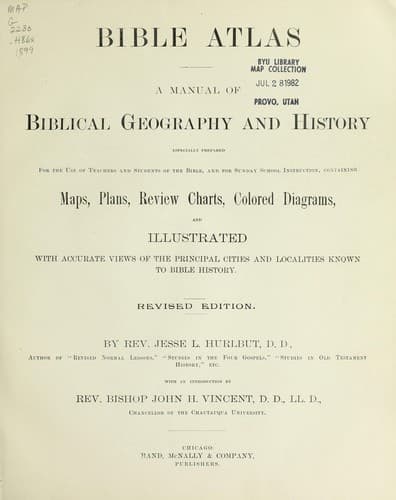
Bible Atlas: A Manual of Biblical Geography and HistoryHurlbut, Jesse Lyman
Religion
Bible Atlas: A Manual of Biblical Geography and History
Hurlbut, Jesse Lyman
Bible -- Geography; Bible -- Geography -- Maps; Bible -- History of Biblical events
1. On the north were the =Hivites=, "that dwelt in Mount Lebanon, from
Mount Baal-hermon unto the entering in of Hamath." (Judges 3:3.) This is
supposed to have been the original home of the race, from which they
journeyed to their seat in Central Palestine. Still further north were
the =Arkites=, the =Sinites=, the =Arvadites= and the =Hamathites=.
2. On the northeast lay the desert, and on the southeast roamed the
=Ammonites=, already mentioned.
3. On the south were several tribes, not all of which can be located
with certainty. In the west, south of the Philistine country, were the
=Amalekites=, a people of unknown origin and predatory habits. South of
Judah were the =Kenites=; and southeast of the Dead Sea, were, in early
times, the Horim (already mentioned), succeeded during the time of the
sojourn by the =Edomites=, a race descended from Esau, who will be
described hereafter. (See explanations to map on page 44.)
With regard to these early inhabitants of Palestine, the following facts
may be noteworthy: 1. In respect to =race=, most of them belonged to the
Hamitic stock; though the origin of the six earliest peoples remains
unknown, and the two latest, the Moabites and Ammonites, were Semites,
and closely related to Israel. 2. As to =language=, they probably spoke
the Hebrew tongue, or one closely allied to it. In Isa. 19:18, the
Hebrew is evidently "the language of Canaan," _i. e._, of the
Canaanites. Whether this language was the one originally spoken by
Abraham's ancestors or not, we have no means of knowing; but it is
possible that it was gained, during the period of the journeyings, from
the Canaanites. 3. In =government=, each village or tribe had its own
ruler, who was called a "_king_"; but his authority was limited by the
"_elders_," a body having influence partly from birth, and partly by
force of character of its members. 4. Their =religion= was widely
different from that of the Hebrews, who, from the age of Abraham,
worshiped one invisible, self-existent, spiritual God. The Canaanites
deified nature under various forms, especially as Baal, the giver of
life, and Ashtoreth (Greek, Astarte), the corresponding female divinity.
Their rites of worship were abominable, cruel and licentious. They
sacrificed not only captured enemies, but their own children, to their
idols, and performed acts of the grossest wickedness at their idolatrous
service. 5. Their =history= is unwritten, save in its tragical close,
the conquest of their land by the Israelites under Joshua, and the
annihilation of many of their races. Still, many lived as a separate
people through all Jewish history; and some of the best scholars are of
opinion that the native population of Palestine at the present time
mainly belongs to this old Canaanite stock.
OUTLINE FOR REVIEW.
I. _Earliest Inhabitants._ Rephaim, Zuzim, Emim, Horim, Avim, Anakim.
Public-domain text, read in full here on John Shaqi.
Reviews
Reviews
No reviews yet
Be the first to share your thoughts on this work.
Elsewhere in the archive
Join the Discussion
Join the discussion
Sign in to leave a comment or review.
Sign InorCreate an account