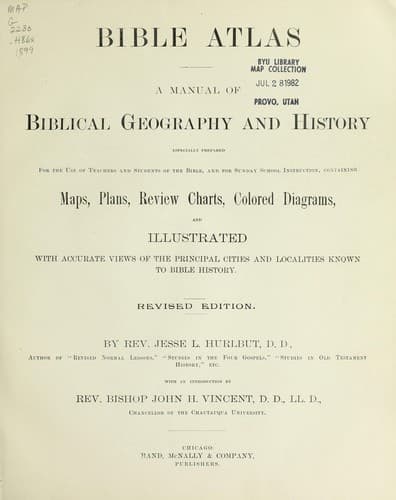
Bible Atlas: A Manual of Biblical Geography and HistoryHurlbut, Jesse Lyman
Religion
Bible Atlas: A Manual of Biblical Geography and History
Hurlbut, Jesse Lyman
Bible -- Geography; Bible -- Geography -- Maps; Bible -- History of Biblical events
III. =Natural Features.= Edom is emphatically a land of mountains. On
the west, along the side of the Arabah, is a line of low limestone
hills. Back of these rise higher, igneous rocks, surmounted by
variegated sandstone, of peculiar color, 2,000 feet high. The eastern
side of the mountains slopes gently away into the Arabian desert. But,
though rough, the land is rich, and the terraced hill-sides have in all
ages been bright with vegetation, and its people have been prosperous.
So the blessing of Esau (Gen. 27:39, 40) has been fulfilled in a land of
"the fatness of the earth, and of the dew of heaven." Its capital during
the Old Testament period was Bozrah (now _Busireh_), near its northern
border. Afterward, Sela, the _Petra_ of remarkable rock-hewn buildings,
arose to prominence. Ezion-geber, at the head of the Gulf of Akaba, was
its seaport.
IV. =History.= Mount Seir was first settled by the Horites, or Horim,
like the inhabitants of Palestine a people of unknown origin. During the
later patriarchal age it was conquered and possessed by Esau, the
brother of Jacob, and ever after occupied by his descendants, the
Edomites. The refusal of this people to allow the Israelites to journey
through their territory compelled them to make a long detour around Edom
on the south and east, and enter Palestine by the land of the Moabites.
During the period of the Judges the Edomites are not mentioned; but they
were beaten by Saul, and thoroughly conquered by David, after a severe
struggle. At the division of the kingdom, B.C. 935, Edom was held by
Judah. Its people rebelled in the time of Jehoram, the son of
Jehoshaphat, and, although defeated by Judah, were able to maintain
their independence. They joined the Chaldeans under Nebuchadnezzar in
the destruction of Jerusalem, for which the later prophecies and psalms
gave them bitter denunciations. About the time of the captivity, B.C.
587-536, the Edomites gained possession of most of the country south of
Judah, extending even to the confines of Egypt. But they lost their own
land, Mount Seir, which became the possession of the Nabatheans. These
were a race, perhaps allied to the Arabians, who laid aside their nomad
habits, and founded a kingdom, whose people grew rich by the caravan
trade. The Edomites, or Idumeans, south of Palestine, were conquered by
the Maccabean princes and incorporated with the Jews, B.C. 130, and the
Nabathean kingdom was annexed to the Roman empire, A.D. 105.
Public-domain text, read in full here on John Shaqi.
Reviews
Reviews
No reviews yet
Be the first to share your thoughts on this work.
Elsewhere in the archive
Join the Discussion
Join the discussion
Sign in to leave a comment or review.
Sign InorCreate an account