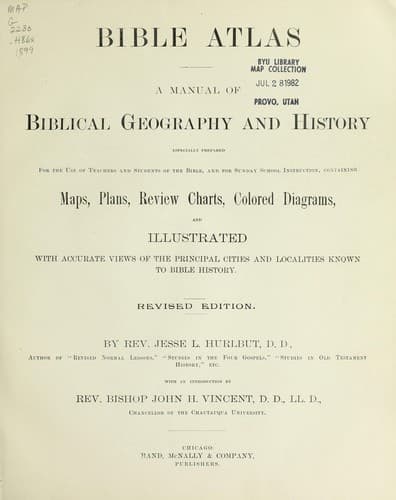
Bible Atlas: A Manual of Biblical Geography and HistoryHurlbut, Jesse Lyman
Religion
Bible Atlas: A Manual of Biblical Geography and History
Hurlbut, Jesse Lyman
Bible -- Geography; Bible -- Geography -- Maps; Bible -- History of Biblical events
I. =From Rameses to the Red Sea.= (Exod. 12-14; Num. 33:5-8.) The
sojourn of the Israelites was passed in the Land of Goshen, between the
Nile and the Isthmus of Suez. The court of the reigning Pharaoh during
the time while Moses was negotiating for the departure of the
Israelites, was at Zoan, or Tanis (Psa. 78:12), the royal city of the
Delta. Rameses, the place of meeting for the Israelites, was probably a
district rather than a city (Gen. 47:8), but may have been at _Abu
Kesheib_. Pithom (Exod. 1:11) has been discovered at _Tell Maskutor_,
ten miles west of Lake Timsah. Succoth, "booths" or "tents," was
probably not a city but a camp, and its location is unknown. Etham,
"wall" (Exod. 13:20), may indicate a place near the great wall which
extended across the isthmus. Pi-hahiroth may be at _Agrud_, near Suez.
Baal-zephon may be the mountain _Jebel Alaka_. The Israelites crossed
the sea at the narrow Strait of Suez, where the distance from shore to
shore is about two-thirds of a mile. At that time the gulf probably
extended several miles north of its present position. The northeast wind
drove out the waters, leaving a path across the gulf, with pools on
either side, as a "wall" or defense to the crossing Israelites.
II. =From the Red Sea to Mount Sinai.= (Exod. 15-19; Num. 33:8-15.) The
general direction can be traced with certainty, but the precise places
of encampment are only conjectural. It is probable that so vast a body
of people, about two millions, must have occupied a large extent of
territory, and the "stations" were the various headquarters of the camp.
This section of the journey was mostly spent in the two narrow plains
along the coast, the Wilderness (or desert) of Etham, and that of Sin.
At Marah (_Ain Hawârah_) the bitter waters were healed; at Elim (_Wady
Ghurundel_) they were refreshed by the "twelve wells and three-score and
ten palm trees." At the next station, No. 9, "the encampment at the Red
Sea," they saw for the last time the waters of the western gulf, and the
land of Egypt beyond them. Here they turned eastward, and, passing the
mountain barrier, entered the Wilderness of Sin. (This is to be
distinguished from the Wilderness of Zin, or the Arabah, on the eastern
side of the peninsula.) In this wild and barren country, food failed
them, and the manna began to be supplied (Exod. 16), to last for forty
years. Their general course was now eastward, through the _wadies_, or
dry beds of winter torrents. At Rephidim (station 13) two events are
recorded as occurring. The want of water led to a miraculous supply from
the smitten rock (Exod. 17:2-7); and the Israelites fought the first
battle in their history, with the wandering Amalekites, who attacked the
rear of the scattered host. Under Joshua, who here appears for the first
time, they were defeated, and devoted to complete destruction. (Exod.
17:8-16; Deut. 25:18.) The next station was Mount Sinai, in front of
which they encamped, probably on the plain _er Rahah_.
Public-domain text, read in full here on John Shaqi.
Reviews
Reviews
No reviews yet
Be the first to share your thoughts on this work.
Elsewhere in the archive
Join the Discussion
Join the discussion
Sign in to leave a comment or review.
Sign InorCreate an account