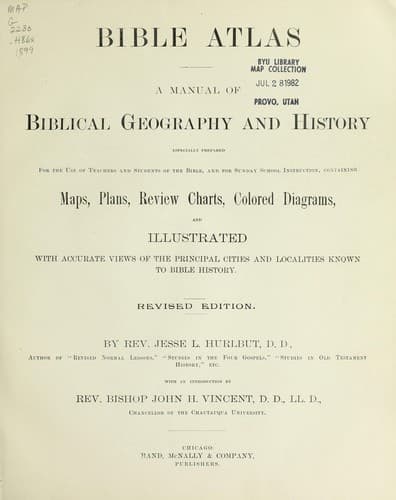
Bible Atlas: A Manual of Biblical Geography and HistoryHurlbut, Jesse Lyman
Religion
Bible Atlas: A Manual of Biblical Geography and History
Hurlbut, Jesse Lyman
Bible -- Geography; Bible -- Geography -- Maps; Bible -- History of Biblical events
retained the old locality on the edge of Edom. Twice the Israelites were
encamped at Kadesh, which marked the beginning and end of the
thirty-eight years' wandering in the Wilderness of Paran. From Kadesh
the twelve spies were sent northward into the Land of Canaan, and the
adverse report of ten of them caused such terror and rebellion in the
host, that God declared that they should not enter the Promised Land
until all that generation should have passed away. (Num. 13, 14.) They
were ordered to turn back into the wilderness, but disobeyed, and,
against their leaders' advice, undertook to force a passage to Canaan,
probably up the pass _es Sufa_. But the inhabitants of the mountains
(Amorites, Canaanites, and Amalekites in alliance) attacked them to
their utter defeat at Hormah, and effectually barred their entrance to
the land through the South Country, as the warlike Philistines had
closed it against them by the way of the plain by the sea. (Exod.
13:17.) Discouraged and despairing, the host of Israel again turned
their faces once more toward the terrible Wilderness of Paran.
IV., V., VI. =From Kadesh-barnea to Mount Hor, Ezion-geber, and Return.=
The period of the next thirty-eight years remains in shadow. Scarcely an
event is named which certainly belongs to this division, the longest by
far in the journey. In the history at Num. 14:45, there is a break in
the record, and other topics are referred to until we find the people at
Kadesh once more, at the end of the 38 years, in chapter 20; and the
list of stations in Num. 33:18-36, is only a barren catalogue of 18
places, in which not one is clearly recognized, and only two or three
can be even guessed at. Some have thought that the entire period was
spent in the Arabah, wandering up and down, as two of the stations
plainly belong there. But it is more probable that the people wandered
over the borders between the Negeb (South Country) and the Wilderness of
Paran. For convenience we may subdivide this period of wandering into
its three journeys. From Kadesh, through 12 unknown stations, to
Moseroth, which is afterward named in the account of Aaron's death
(Deut. 10:6), showing that it was near Mount Hor. This is indicated on
the Map as Journey IV. Journey V. was from Mount Hor down the Arabah
southward to Ezion-geber, at the head of the Ælanitic Gulf. Journey VI.
was once more through the Arabah, northward to Kadesh-barnea, completing
the period of the punishment for the rebellion of 38 years before. Here
three events took place. 1. The rock was smitten by Moses, when God had
bidden him speak to it, in order to bring forth water; and, as a
penalty, he was not permitted to enter Canaan. (Num. 20:1-13.) 2. The
Israelites asked of the Edomites (on whose western border they were
encamped at Kadesh), the privilege of crossing their territory on their
journey to Canaan, but their request was denied. 3. Soon after this, the
king of the Canaanite city of Arad, in the Negeb, or South Country, 20
Public-domain text, read in full here on John Shaqi.
Reviews
Reviews
No reviews yet
Be the first to share your thoughts on this work.
Elsewhere in the archive
Join the Discussion
Join the discussion
Sign in to leave a comment or review.
Sign InorCreate an account