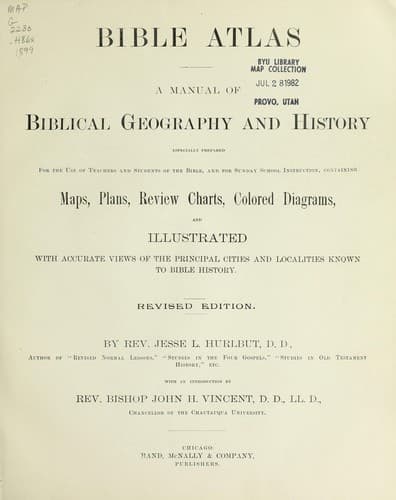
Bible Atlas: A Manual of Biblical Geography and HistoryHurlbut, Jesse Lyman
Religion
Bible Atlas: A Manual of Biblical Geography and History
Hurlbut, Jesse Lyman
Bible -- Geography; Bible -- Geography -- Maps; Bible -- History of Biblical events
This was undertaken by Joshua after the death of Moses, and, as far as
can be ascertained from the record, was accomplished in three campaigns.
The war began with the passage of the Jordan, B.C. 1210, and, so far as
active hostilities were concerned, was finished in seven years. But the
great mass of the native population remained upon the soil, to plague
the Chosen People by the influence of their wickedness, so that the
conquest was never thoroughly completed. Indeed, some writers think that
the inhabitants of Palestine at the present time belong mainly to the
old Canaanite stock, which has perpetuated itself under all the changes
of government.
1. =The Conquest of Central Palestine.= (Josh. 3-8.) According to the
account in the book of Joshua, this was a brief campaign; but the
Samaritan records relate a series of supplementary sieges and battles,
which would indicate that the war may have been longer than appears.
Still, there are evidences that the Hivites and Perizzites, who occupied
most of this district, were peaceful peoples, readily yielding to the
conquerors, so that the resistance was less stubborn than in other
sections. The war began with the passage of the Jordan, an event ever
kept in mind as the entrance of the people upon their own land. They
pitched their camp at Gilgal, in the Jordan Valley, and fortified the
place as a permanent headquarters during the entire period of conquest.
(Josh. 5.) Jericho was first taken, by supernatural aid, and devoted to
God as the first fruits of conquest. (Josh. 6.) An act of trespass
against God by Achan, caused a defeat at Ai (near Bethel), the next
place attacked; but the sin was punished, and, by a stratagem and
ambush, Ai was taken. They then marched northward to Shechem, an ancient
Hivite city, of which the last previous account is its destruction by
the sons of Jacob. (Gen. 34.) It may not have been rebuilt, as we find
at this time the Hivites occupying a number of towns at a distance from
it (Gibeon and others, Josh. 9); or it may have submitted to the
overwhelming power of Israel. In the Vale of Shechem, between the
mountains Ebal and Gerizim, all the Israelites were assembled, the law
was read in their hearing, and memorial stones were erected. After this,
the Hivites of four villages, of which Gibeon was the most important, by
means of a deception made a treaty of peace with the Israelites, and
obtained a pledge of protection; being the only nation in all the land
formally spared from destruction. Their deceit was soon discovered; but
the word of Israel was kept, though the people of the four villages were
reduced to the condition of "servants of the sanctuary," _i. e._,
employed in the menial duties of the Tabernacle. The central portion of
the land was now possessed by Israel, from Jericho and Gibeon northward
to the Carmel range of mountains, and the army returned to the fortified
camp at Gilgal. (Josh. 9.)
Public-domain text, read in full here on John Shaqi.
Reviews
Reviews
No reviews yet
Be the first to share your thoughts on this work.
Elsewhere in the archive
Join the Discussion
Join the discussion
Sign in to leave a comment or review.
Sign InorCreate an account