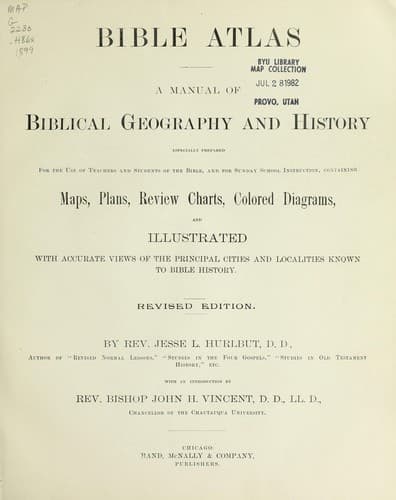
Bible Atlas: A Manual of Biblical Geography and HistoryHurlbut, Jesse Lyman
Religion
Bible Atlas: A Manual of Biblical Geography and History
Hurlbut, Jesse Lyman
Bible -- Geography; Bible -- Geography -- Maps; Bible -- History of Biblical events
THE division of the land among the Twelve Tribes took place in three
stages. 1. After the conquest of Eastern Palestine, during the lifetime
of Moses, the two tribes of Reuben and Gad and half the tribe of
Manasseh received their portion, on condition that their warriors should
aid their kinsmen in the war for the rest of the land. (Num. 32.) 2.
After the campaigns in Western Palestine (see last map and
explanations), the two leading tribes of Judah and Ephraim and the
remaining half of Manasseh received their inheritance, and took
possession of it, as far as conquered: Judah in the south, Ephraim a
small but choice portion in the centre, and Manasseh immediately north
of it. (Josh. 15-17.) 3. The remaining seven tribes delayed long in
obtaining their portions in the land, but at last, after a rebuke from
the aged Joshua for their slowness, made the division by lot, and
entered upon their inheritance. (Josh. 18, 19.) The cities of refuge,
and those for the priests and Levites, were last of all appointed, late
in the life of Joshua, and then "the land had rest from war," and Israel
entered upon its history in its own land.
It is not easy to fix the tribal boundary lines, since some tribes
possessed cities within the domain of other tribes, and the boundaries,
if not entirely indeterminate, varied greatly in different ages.
Geographers are agreed upon the general position, but not upon the
precise boundary lines. We follow the map of Dr. James Strong, in
McClintock and Strong's Cyclopedia.
[Illustration: VIEW IN THE EASTERN TABLE-LAND--BASHAN.]
I. =The Tribe of Reuben= (Num. 32:1-38; Josh. 13:15-23) had the river
Arnon for its southern border, this river separating it from Moab. It
was bounded on the east by the Syrian desert, and on the west by the
Dead Sea and the lower end of the Jordan. Its northern line began at
Beth-jeshimoth, and extended northeasterly to near Rabbath Ammon. Its
territory consisted of a low region by the sea and the river, a
precipitous mountain range, and a rolling plateau eastward, well adapted
for pasture. Among its prominent localities were: Heshbon, the capital
of the Amorite king, Sihon; Dibon, where recently the Moabite stone was
discovered; Mount Nebo, where Moses died; Bezer, a city of refuge;
Aroer, Ataroth, Medeba, Kiriathaim, and Kedemoth.
Public-domain text, read in full here on John Shaqi.
Reviews
Reviews
No reviews yet
Be the first to share your thoughts on this work.
Elsewhere in the archive
Join the Discussion
Join the discussion
Sign in to leave a comment or review.
Sign InorCreate an account