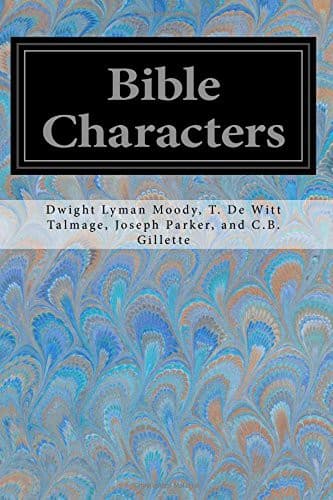
Bible CharactersTalmage, T. De Witt (Thomas De Witt)
Religion
Bible Characters
Talmage, T. De Witt (Thomas De Witt)
Bible -- Biography
It is not easy to begin life by a destructive process of reformation.
Who would not rather plant a tree than throw down a wall? Who would not
rather plant flowers and enjoy their beauty and fragrance than give
himself the severe toil and the incessant trouble of destroying corrupt
and evil institutions?
Whoever attempts this kind of destructive work, or even a constructive
work which involves preliminary destructiveness, will have a hard time of
it. Criticism will be very sharp, and selfishness will be developed in an
extraordinary degree.
If a man be more than politician--if he be a real born statesman, looking
at whole empires at once and not at mere parishes, and if in his thought
and purpose he should base his whole policy upon fundamental right--he
will not have an easy life of it, even in a Christian country. In
proportion as he bases his whole policy on righteousness, temperance and
judgment to come, he will be pelted with hard names and struck at with
unfriendly hands.
This holds good in all departments of life, in all great reformations, in
all assaults made upon ignorance, selfishness, tyranny and wrong of every
name.
The children of Israel always seemed to live a foolish life. They were
the veriest children--so, at least, we would say but for fear of branding
sweet children with an evil stigma.
They were infantile, weak, treacherous to themselves, uncertain at every
point--and so, having kept the brazen serpent, they burned incense to
it. They liked a visible God. When the calf appealed to their religious
feelings they danced around it as if at last they had found a deity.
But who can worship a spirit--invisible, impalpable, far away, near at
hand, without a name, without a shape which we can verify and say: “It
comes to thus much, and this is the weight and this is the value of it?”
It requires a mind of some mental strength to stand up, take hold of the
brazen serpent and call it “Nehushtan”--a contemptuous term, meaning a
piece of brass; dead brass, useless and worthless brass, a relic but not
a God.
Let us give credit to the men who have been bold--religiously
intrepid--in the midst of circumstances of a most discouraging and
overbearing kind. They are the men to whom we owe our present privileges.
We have the Bible in our mother tongue because they were valiant. Not a
church would have been built today in which men could assemble with a
sense of freedom--sweet, joyous liberty--but for the Hezekiahs and others
who went forth and, at great cost and great peril, destroyed things evil
and black, by the power of God’s almightiness--overthrew them, and set up
a better kingdom.
What was the root of Hezekiah’s character? At present we have seen
phenomena of a gracious kind; we like what we have seen of this man.
Public-domain text, read in full here on John Shaqi.
Reviews
Reviews
No reviews yet
Be the first to share your thoughts on this work.
Elsewhere in the archive
Join the Discussion
Join the discussion
Sign in to leave a comment or review.
Sign InorCreate an account