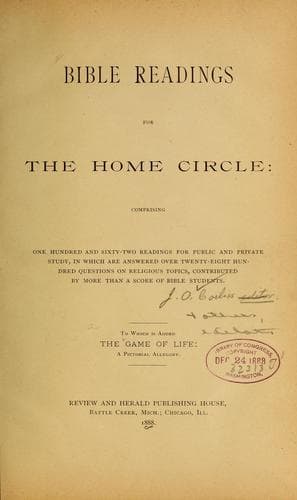
Bible -- Illustrations; Bible -- Indexes; Bible -- Study and teaching
“We teach and define that it is a dogma divinely revealed; that
the Roman pontiff, when he speaks _ex cathedra_, that is, when in
the discharge of the office of Pastor and Doctor of all
Christians, by virtue of his supreme apostolic authority he
defines a doctrine regarding faith or morals to be held by the
universal church, by the divine assistance promised to him in
blessed Peter, is possessed of that infallibility with which the
divine Redeemer willed that His church should be endowed for
defining doctrine regarding faith or morals; and that therefore
such definitions of the Roman pontiff are irreformable of
themselves, and not from the consent of the church.”—_Id., page
218._
“Should Jesus Christ come in person from heaven into a church to
administer the sacrament of reconciliation, and should He say to a
penitent, ‘I absolve thee,’ and should a priest sitting at His
side in the tribunal of penance pronounce over a penitent the
selfsame words, ‘I absolve thee,’ there is no question that in the
latter case, as in the former, the penitent would be equally
loosed from his sin.”—_“__Jesus Living in the Priest,__”__ by the
Rev. P. Millet, S. J., English translation by the Rt. Rev. Thomas
Sebastian Byrne, D. D., bishop of Nashville; New York, Benziger
Brothers, printers to the Holy Apostolic See, 1901, pages 23, 24.
Imprimatur, Michael Augustine, archbishop of New York._
Among the twenty-seven propositions known as the “Dictates of
Hildebrand,” who, under the name of Gregory VII, was Pope from
1073-87, occur the following:—
“2. That the Roman pontiff alone is justly styled universal.
“6. That no person ... may live under the same roof with one
excommunicated by the Pope.
“9. That all princes should kiss his feet only.
“12. That it is lawful for him to depose emperors.
“18. That his sentence is not to be reviewed by any one; while he
alone can review the decisions of all others.
“19. That he can be judged by no one.
“22. That the Romish Church never erred, nor will it, according to
the Scriptures, ever err.
“26. That no one is to be accounted a Catholic who does not
harmonize with the Romish Church.
“27. That he can absolve subjects from their allegiance to
unrighteous rulers.”—_Annals of Baronius, 1076, Vol. XI, col. 506.
See Gieseler’s __“__Ecclesiastical History,__”__ third period,
div. 3, par. 47, note 3; and Mosheim’s __“__Ecclesiastical
History,__”__ book 3, cen. 11, part 2, chap. 2, par. 9, note._
Public-domain text, read in full here on John Shaqi.
Reviews
Reviews
No reviews yet
Be the first to share your thoughts on this work.
Elsewhere in the archive
Join the Discussion
Join the discussion
Sign in to leave a comment or review.
Sign InorCreate an account