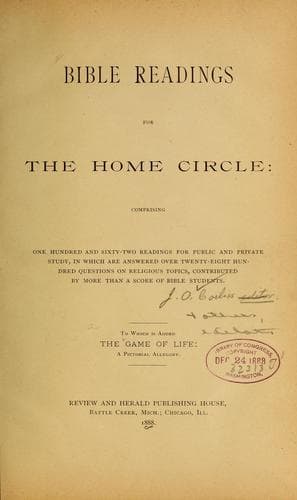
Bible -- Illustrations; Bible -- Indexes; Bible -- Study and teaching
In Dan. 8:11-13, in the Revised Version, the words “burnt
offering” have been supplied by the translators after the word
“continual,” but this rendering seems to place too restricted a
meaning upon the word “continual.” The fact that no word is
connected with “continual” in the original text, although in the
typical service of the sanctuary it is used with “burnt offering”
(Ex. 29:42), with “incense” (Ex. 30:8, here rendered perpetual),
and with “showbread” (Num. 4:7), indicates that that which is
continual represents the _continual service or mediation of Christ
in the heavenly sanctuary_, in which all that was continual in the
typical service found its antitype and fulfilment. See Heb. 6:19,
20; 7:1-3, 14-16, 23-25. The action which made the Pope the vicar
of God and the high priest of the apostasy, really took away from
Christ, as far as human intent and power were concerned, his place
and work as the only mediator between God and man (1 Tim. 2:5),
and this took away from Him, as far as man could take it away, the
continual mediation, according to the prediction in this prophecy.
The prophecies of Daniel are cumulative and widening in their
view, each carrying matters farther than the preceding one, and
bringing out more explicitly and more in detail important features
down the stream of time. In Daniel 2, under the fourth universal
kingdom, the Papacy is not represented under any direct symbol or
figure at all,—simply Rome in its united and divided state; in
Daniel 7 Rome is symbolized by the “little horn” coming up among
the ten horns representing the divided state of Rome; while in
Daniel 8 the only figure used to represent the fourth world power
is the “little horn” which waxed “exceeding great.”
In each of these last two chapters the little horn is introduced
to tell especially of the workings of the same terrible power—Rome
papal. Both chapters deal with the same great apostasy. In the
seventh chapter, the little horn takes away _the law of God_. In
the eighth chapter, it takes away _the gospel_. Had it taken away
only the law, this would have vitiated the gospel; for, with the
law of God gone, even the _true_ gospel could not save, because
the law is needed to convict and give a knowledge of sin. And had
the Papacy taken away only the gospel, and left the law, salvation
through such a system would still have been impossible, for there
is no salvation for sinners through even the law of God itself
apart from Christ and the gospel. But to make apostasy doubly
sure, this power changes, vitiates, and takes away both the _law_
and the _gospel._
Public-domain text, read in full here on John Shaqi.
Reviews
Reviews
No reviews yet
Be the first to share your thoughts on this work.
Elsewhere in the archive
Join the Discussion
Join the discussion
Sign in to leave a comment or review.
Sign InorCreate an account