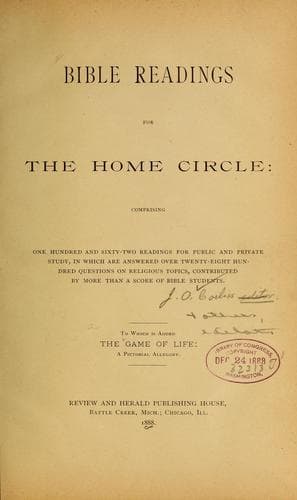
Bible -- Illustrations; Bible -- Indexes; Bible -- Study and teaching
NOTES.—Inasmuch as the taking away of the continual mediation of
Christ is made the beginning of a prophetic period, there must be
some definite act at some definite time which, in form and intent,
takes from Christ His priestly work in the heavenly sanctuary.
This act was the official decree of an ecclesiastical council held
at Rome in 503 A.D., by which it was declared “that the Pope was
judge as God’s vicar, and could himself be judged by no one.” See
Hardouin’s “Councils,” Vol. II, page 983; Labbe and Cossart’s
“Councils,” Vol. IV, col. 1364; and Bower’s “History of the Popes”
(three-volume edition), Vol. I, pages 304, 305. The work of
Clovis, king of the Franks, who earned for himself the title of
“the eldest son of the church” by his campaigns to subdue the
kingdoms hostile to the Papacy, contributed much toward putting
into practical effect this claim of the Papacy, which finally
resulted in establishing the Pope as the head of the Roman
priesthood which has usurped the priestly work of Christ, and has
established another system of mediation in its place. This work of
Clovis came to its climax in the period 503-508, and this period
therefore becomes the natural one from which to date the 1290
years of Dan. 12:11, which would accordingly end in the period
1793-98, at the same time as the 1260 years of Dan. 7:25. See
notes on page 223.
“With Rome would have fallen her bishop, had he not, as if by
anticipation of the crisis, reserved till this hour the
master-stroke of his policy. He now boldly cast himself upon an
element of much greater strength than that of which the political
convulsions of the time had deprived him; namely, that the bishop
of Rome is the successor of Peter, the prince of the apostles,
and, in virtue of being so, is Christ’s vicar on earth. In making
this claim, the Roman pontiffs vaulted at once over the throne of
kings to the seat of gods: Rome became once more the mistress of
the world, and her popes the rulers of the earth.”—_“__The
Papacy__”__ by J. A. Wylie, page 34._
23. What assurance was given to Daniel concerning the period of time
mentioned in verse 14?
“And the vision of the evening and the morning which was told _is true_;
wherefore shut thou up the vision; for it shall be for many days.” Dan.
8:26.
NOTES.—By the expression “the vision of the evening and the
morning” reference is made to the vision concerning the
twenty-three hundred days, as may be seen by referring to the
marginal readings of Dan. 8:14.
The interpretation of the vision of chapter 8 closes without
making any explanation of the long period of time which was
mentioned to Daniel in the answer to the question, “How long shall
be the vision?” This important feature was left to be interpreted
later. See next reading.
Public-domain text, read in full here on John Shaqi.
Reviews
Reviews
No reviews yet
Be the first to share your thoughts on this work.
Elsewhere in the archive
Join the Discussion
Join the discussion
Sign in to leave a comment or review.
Sign InorCreate an account