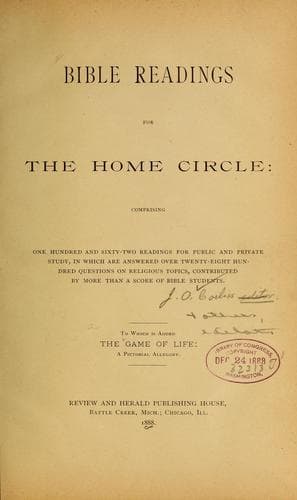
Bible -- Illustrations; Bible -- Indexes; Bible -- Study and teaching
NOTES.—Literal Jerusalem was given into the hands of ancient
Babylon, and the typical service in the earthly sanctuary was thus
taken away. Dan. 1:1, 2. This was prophetic of the experience of
spiritual Jerusalem in modern Babylon, foretold in the prophecies
of Daniel and John, and of the taking away of the mediation of
Christ in the heavenly sanctuary. Dan. 7:25; 8:13. These two
visions expose the work of modern Babylon, the Papacy, and
determine the limit of its permitted power over the people of God,
and of its perversion of the gospel of Christ in substituting
another mediatorial system for the work of Christ in the heavenly
sanctuary.
The general theme upon which the book of Daniel treats is Babylon,
both ancient and modern. Chapters 1-6, inclusive, present certain
historical facts leading up to the fall of ancient Babylon, and an
attempt to destroy the prophet Daniel himself and the final
attempt to destroy the people of God,—a brief historical outline,
which is in itself a prophecy of modern Babylon. Chapters 7-12,
inclusive, contain prophecies relating especially to modern
Babylon, which supplement the historical prophecy of the previous
chapters, and which enable us to draw a very exact and striking
parallel between ancient and modern Babylon. A brief outline of
this parallel may be stated thus:—
(1) In the religion of ancient Babylon, image-worship found a
prominent place. The same is true of modern Babylon.
(2) Ancient Babylon affirmed that the gods (or God) dwelt not in
the flesh. By the dogma of the immaculate conception of the Virgin
Mary (that is, that she herself was born without the taint of
original sin), modern Babylon teaches that God, in the person of
His Son, did not take the same flesh with us; that is, sinful
flesh.
(3) Ancient Babylon persecuted those who refused to accept her
dogmas and worship according to her laws. Modern Babylon has done
the same.
(4) The king of ancient Babylon set himself above God, and
attempted to make his kingdom an everlasting kingdom. So does
modern Babylon.
(5) Ancient Babylon rejected the true gospel as taught to
Nebuchadnezzar, and the fall of Babylon came in consequence.
Modern Babylon has done the same in her rejection of the true
gospel as brought to her in the Reformation, and her fall is
inevitable and impending.
(6) The fall of ancient Babylon came just at the time when it was
giving expression to its contempt of all its enemies, and its
confidence in its own permanence. This experience will be repeated
in the history of modern Babylon.
17. What prophetic period, therefore, extends to the deliverance of God’s
people from the captivity in modern Babylon, and the restoration to them
of the mediation of Christ?
Public-domain text, read in full here on John Shaqi.
Reviews
Reviews
No reviews yet
Be the first to share your thoughts on this work.
Elsewhere in the archive
Join the Discussion
Join the discussion
Sign in to leave a comment or review.
Sign InorCreate an account