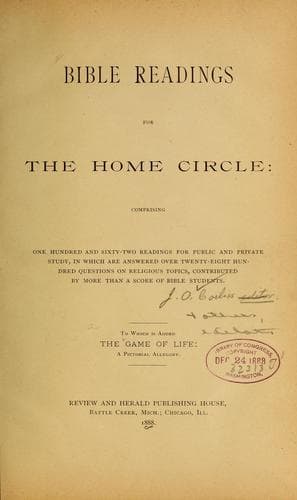
Bible -- Illustrations; Bible -- Indexes; Bible -- Study and teaching
NOTE.—After a person discovered his sin by the law which demanded
the death of the transgressor, he first brought his offering, then
he confessed his sin while laying his hands on the head of the
victim, thus, in figure, transferring his sin to the victim; the
victim was next slain in the court, or outer part of the
sanctuary, and its blood put on the horns of the altar and poured
at the foot of the altar. In this way sins were pardoned, and, in
the typical service, transferred to the sanctuary.
13. After the accumulation of the sins of the year in this way, what
service took place on the tenth day of the seventh month of each year?
“And this shall be a statute forever unto you: that in the seventh month,
on the tenth day of the month, ye shall afflict your souls, ... for _on
that day shall the priest make an atonement for you, to cleanse you, that
ye may be clean from all your sins before the Lord_.” Lev. 16:29, 30.
14. How was the sanctuary itself to be cleansed, and how were the sins of
the people to be finally disposed of?
“And he [the high priest] shall take of the congregation of the children
of Israel two kids of the goats for a sin-offering.... And he shall take
the two goats, and present them before the Lord at the door of the
tabernacle of the congregation. And Aaron shall cast lots upon the two
goats, one lot _for the Lord_, and the other lot _for the scapegoat_.”
Verses 5-8.
NOTE.—The Hebrew word for scapegoat is Azazel. See margin of verse
8. It is used as a proper name, and, according to the opinion of
the most ancient Hebrews and Christians, refers to Satan, or the
angel who revolted and persisted in rebellion and sin.
15. What was done with the blood of the goat upon which the Lord’s lot
fell?
“Then shall he kill the goat of the sin-offering, that is for the people,
and bring his blood within the veil, ... _and sprinkle it upon the
mercy-seat_, and before the mercy-seat.” Verse 15.
16. Why was it necessary to make this atonement?
“And he shall make an atonement for the holy place, _because of the
uncleanness of the children of Israel, and because of their transgressions
in all their sins_: and so shall he do for the tabernacle of the
congregation, that remaineth among them in the midst of their
uncleanness.” Verse 16.
NOTE.—Sins were conveyed into the sanctuary during the year by the
blood of the personal sin-offerings offered daily at the door of
the tabernacle. Here they remained until the day of atonement,
when the high priest went into the most holy place with the blood
of the goat on which the Lord’s lot fell; and, bearing the
accumulated sins of the year in before the mercy-seat, he there,
in type, atoned for them, and so cleansed the sanctuary.
17. After having made atonement for the people in the most holy place,
what did the high priest next do?
Public-domain text, read in full here on John Shaqi.
Reviews
Reviews
No reviews yet
Be the first to share your thoughts on this work.
Elsewhere in the archive
Join the Discussion
Join the discussion
Sign in to leave a comment or review.
Sign InorCreate an account