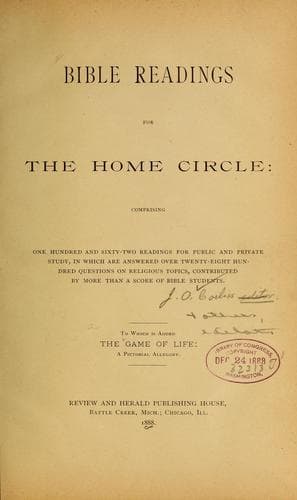
Bible -- Illustrations; Bible -- Indexes; Bible -- Study and teaching
“Except those days should be shortened, _there should no flesh be saved_:
but for the elect’s sake those days shall be shortened.” Matt. 24: 22.
14. Still bent on persecution, how does Satan manifest his enmity against
the remnant church?
“And the dragon was wroth with the woman, and _went to make war with the
remnant of her seed_, which keep the commandments of God, and have the
testimony of Jesus Christ.” Rev. 12:17.
NOTE.—To the very end, Satan will persecute and seek to destroy
the people of God. Against the remnant, or last portion of the
church, he is especially to make war. Their obedience to God’s
commandments, and their possession of the testimony of Jesus, or
spirit of prophecy (Rev. 19:10), are especially offensive to him,
and excite his intense ire.
‐‐‐‐‐‐‐‐‐‐‐‐‐‐‐‐‐‐‐‐‐‐‐‐‐‐‐‐‐‐‐‐‐‐‐‐‐
Soldiers of Christ, arise,
And put your armor on;
Fight, for the battle will be ours;
We fight to win a crown.
We fight not against flesh,
We wrestle not with blood;
But principalities and powers,
And for the truth of God.
CHARLES WESLEY.
A Great Persecuting Power (The Ten-Horned Beast of Revelation 13)
[Illustration.]
Early Christian Martyrs. "He shall ... wear out the saints of the Most
High." Dan. 7:25.
1. What is the first symbol of Revelation 13?
“And I stood upon the sand of the sea, and saw _a beast rise up out of the
sea, having seven heads and ten horns_, and upon his horns ten crowns and
upon his heads the name of blasphemy.” Rev. 13:1.
NOTES.—As already learned from studying the book of Daniel, a
beast in prophecy represents some great earthly power or kingdom;
a head, a governing power; horns, a number of kingdoms; crowned
heads or crowned horns, political rulership; waters, “peoples, and
multitudes, and nations, and tongues.” Rev. 17:15.
“The beasts of Daniel and John are empires. The ten-horned beast
is the Roman power.... The head is the governing power of the
body. The heads of this beast represent successive
governments.”—_“__Romanism and the Reformation,__”__ by H. Grattan
Guinness, pages 144, 145._
2. How is this beast further described?
“And the beast which I saw was _like unto a leopard_, and his feet were as
_the feet of a bear_, and his mouth as _the mouth of a lion_.” Verse 2,
first part.
Public-domain text, read in full here on John Shaqi.
Reviews
Reviews
No reviews yet
Be the first to share your thoughts on this work.
Elsewhere in the archive
Join the Discussion
Join the discussion
Sign in to leave a comment or review.
Sign InorCreate an account