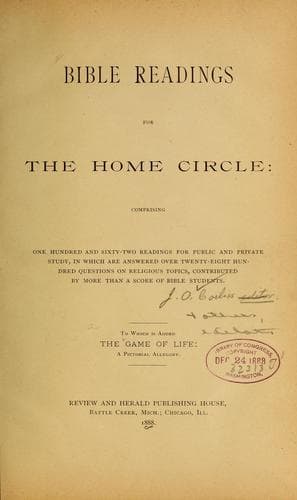
Bible -- Illustrations; Bible -- Indexes; Bible -- Study and teaching
NOTE.—The number _seven_ in the Scriptures denotes completion or
perfection. The seven seals embrace the whole of a class of events
in which is narrated the history of the church from the beginning
of the Christian era to the second coming of Christ. The white
horse, with his rider going forth to conquer, fitly represents the
early Christian church in its purity, going into all the world
with the gospel message of salvation.
5. What appeared upon the opening of the second seal?
“And when He had opened the second seal, ... there went out _another horse
that was red_: and power was given to him that sat thereon to take peace
from the earth, and that they should kill one another: and there was given
unto him a great sword.” Verses 3, 4.
NOTE.—As whiteness in the first horse denoted the purity of the
gospel which its rider propagated, so the color of the second
horse would show that corruption had begun to creep in when this
symbol applies. It is true that such a state of things did succeed
the apostolic church. Speaking of the second century, Wharey, in
his “Church History,” page 39, says: “Christianity began already
to wear the garb of heathenism. The seeds of most of those errors
that afterwards so entirely overran the church, marred its beauty,
and tarnished its glory, were already beginning to take root.”
Worldliness came in. The church sought alliance with the secular
power, and trouble and commotion were the result. This symbol
extends from the close of the first century to the time of
Constantine, when a complete union of church and state was
effected.
6. What was the color of the symbol under the third seal?
“When He had opened the third seal, I heard the third beast say, Come and
see. And I beheld, and lo _a black horse_; and he that sat on him had a
pair of balances in his hand.” Verse 5.
NOTE.—The “black” horse fitly represents the spiritual darkness
that characterized the church from the time of Constantine till
the establishment of papal supremacy in 538 A.D. Of the condition
of things in the fourth century, Wharey (page 54) says:
“Christianity had now become popular, and a large proportion,
perhaps a large majority, of those who embraced it, only assumed
the name, received the rite of baptism, and conformed to some of
the external ceremonies of the church, while at heart and in moral
character they were as much heathen as they were before. Error and
corruption now came in upon the church like a flood.”
7. What were the color and character of the fourth symbol?
Public-domain text, read in full here on John Shaqi.
Reviews
Reviews
No reviews yet
Be the first to share your thoughts on this work.
Elsewhere in the archive
Join the Discussion
Join the discussion
Sign in to leave a comment or review.
Sign InorCreate an account