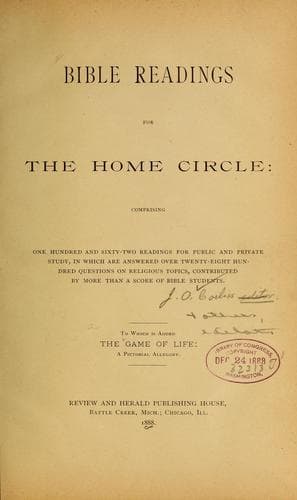
Bible -- Illustrations; Bible -- Indexes; Bible -- Study and teaching
“And they had _a king_ over them, which is the angel of the bottomless
pit, whose name in the Hebrew tongue is Abaddon, but in the Greek tongue
hath his name Apollyon [margin, a destroyer].” Verse 11.
NOTES.—For hundreds of years the Mohammedans and invading Tartar
tribes, like the locusts (Prov. 30:27), had no general government
or king over them, but were divided into bands, or factions, under
separate leaders. But in the twelfth century Temuljin, king of the
Mongols, or Moguls, who is described as “the most terrible scourge
that ever afflicted the human race,” built up an empire “at the
cost,” it is estimated, says Myers in his “General History,” page
461, of “fifty thousand cities and towns and five million lives.”
This was followed by the more permanent Tartar empire founded by
Othman a century later, commonly known as the Ottoman Empire, and
ruled by the sultan.
From the first, the great characteristic of the Turkish government
has been that of a “destroyer.” Speaking of a war by the Turks
upon the Byzantine Empire in 1050, Gibbon (chapter 57) says: “The
myriads of Turkish horse overspread a frontier of six hundred
miles from Tauris to Erzeroum, and the blood of one hundred and
thirty thousand Christians was a grateful sacrifice to the Arabian
prophet.”
In 1058 the Turks wrested the Holy Land from the Saracens,
desecrated the holy places, and treated the pilgrims to Jerusalem
with cruelty. This brought on the nine unsuccessful crusades of
the next two centuries for the recovery of the Holy Land.
12. What definite period is mentioned under this trumpet?
“And they had tails like unto scorpions, and there were stings in their
tails: and their power was to hurt men _five months_.” Verse 10. See also
verse 5.
NOTES.—“It was on the twenty-seventh of July, in the year 1299,”
says Gibbon, “that Othman first invaded the territory of
Nicomedia,” in Asia Minor, “and the singular accuracy of the
date,” he adds, “seems to disclose some foresight of the rapid and
destructive growth of the monster.”—_“__Decline and Fall of the
Roman Empire,__”__ chap. 64, par. 14_ This, then, we take to be
the beginning of the period referred to.
A Bible month consists of thirty days; five months would be 150
days. Allowing a day for a year, 150 years from July 27, 1299,
would reach to July 27, 1449. During this period the Turks were
engaged in almost constant warfare with the Greek Empire, and yet
without conquering it.
13. With what statement does the fifth trumpet close?
“One woe is past; and, behold, there come two woes more hereafter.” Verse
12.
14. What command is given under the sixth trumpet?
Public-domain text, read in full here on John Shaqi.
Reviews
Reviews
No reviews yet
Be the first to share your thoughts on this work.
Elsewhere in the archive
Join the Discussion
Join the discussion
Sign in to leave a comment or review.
Sign InorCreate an account