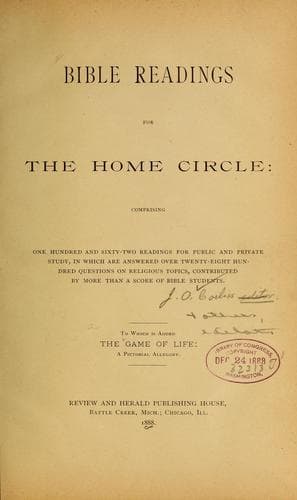
Bible -- Illustrations; Bible -- Indexes; Bible -- Study and teaching
NOTES.—The winter would be an unfavorable time in which to flee,
entailing discomfort and hardship; and an attempt to flee on the
Sabbath day would doubtless have been met with difficulty, so
false and pharisaical were the notions of the Jews respecting the
true character and object of the Sabbath. See Matt. 12:1-14; Luke
13:14-17; Mark 1:32; 2:23-28; John 5:10-18.
The prayers of Christ’s followers were heard. Events were so
over-*ruled that neither Jews nor Romans hindered the flight of
the Christians. Upon the retreat of Cestius, the Jews pursued
after his army, and the Christians thus had an opportunity to
leave the city. The country also had been cleared of enemies who
might have endeavored to intercept them. At the time of this
siege, the Jews were assembled at Jerusalem to keep the Feast of
Tabernacles, and thus the Christians of Judea were able to escape
unmolested, and in the autumn, a most favorable time for flight.
15. What trying experience did Christ then foretell?
“For _then shall be great tribulation_, such as was not since the
beginning of the world to this time, no, nor ever shall be.” Verse 21.
NOTES.—In paragraph 4 of his preface to his “Wars of the Jews,”
Josephus, referring to the destruction of Jerusalem, says: “The
misfortunes of all men, from the beginning of the world, if they
be compared to these of the Jews, are not so considerable.” In
this terrible calamity, the prophecy of Moses recorded in Deut.
28:47-53, was literally fulfilled. He said, “Thou shalt eat the
fruit of thine own body, the flesh of thy sons and of thy
daughters, ... in the siege, and in the straitness, wherewith
thine enemies shall distress thee.” For an account of the
fulfilment of this, see Josephus’s “Wars of the Jews,” book 6,
chap. 3, par. 4.
Following the destruction of Jerusalem came the persecution of the
early Christians under the pagan emperors during the first three
centuries of the Christian era, that begun under Diocletian in 303
A.D., and continuing for ten years (Rev. 2:10), being the most
bitter and extensive persecution of God’s people the world had yet
witnessed. Following this came the still greater and more terrible
persecution of the saints during the long centuries of papal
supremacy, foretold in Dan. 7:25 and Rev. 12:6. All these
tribulations occurred under either pagan or papal Rome.
16. For whose sake did Christ say the period of papal persecution would be
shortened?
“And except those days should be shortened, there should no flesh be
saved: but _for the elect’s sake those days shall be shortened_.” Verse
22.
Public-domain text, read in full here on John Shaqi.
Reviews
Reviews
No reviews yet
Be the first to share your thoughts on this work.
Elsewhere in the archive
Join the Discussion
Join the discussion
Sign in to leave a comment or review.
Sign InorCreate an account