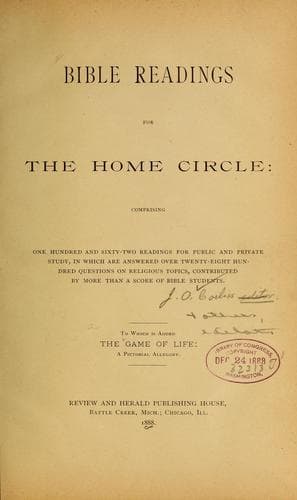
Bible -- Illustrations; Bible -- Indexes; Bible -- Study and teaching
“In some places persons could not see to read common print in the
open air for several hours together. Birds sang their evening
song, disappeared, and became silent; fowls went to roost; cattle
sought the barn-yard; and candles were lighted in the houses. The
obscuration began about ten o’clock in the morning, and continued
until the middle of the next night, but with differences of degree
and duration in different places.... The true causes of this
remarkable phenomenon are not known.”—_Webster’s Unabridged
Dictionary, edition 1883, page 1604, in article __“__The Dark
Day.__”_
Herschel, the great astronomer, says: “The dark day in Northern
America was one of those wonderful phenomena of nature which will
always be read with interest, but which philosophy is at a loss to
explain.” The darkness was not caused by any eclipse of the sun by
the moon, for the moon had fulled only the night before, and
consequently was on the opposite side of the earth from the sun.
“The darkness of the following evening was probably as deep and
dense as ever had been observed since the Almighty first gave
birth to light; it wanted only palpability to render it as
extraordinary as that which overspread the land of Egypt in the
days of Moses. If every luminous body in the universe had been
shrouded in impenetrable shades, or struck out of existence, it
was thought the darkness could not have been more complete. A
sheet of white paper, held within a few inches of the eyes, was
equally invisible with the blackest velvet.”—_“__Our First
Century,__”__ by R. M. Devins, page 94._
The darkness of the night was as supernatural as that of the
previous day, from the fact, as stated by Dr. Adams, that “the
moon had fulled the day before.”
10. When was there a remarkable display of falling stars?
Nov. 13, 1833.
NOTES.—The celebrated astronomer and meteorologist, Professor
Olmsted, of Yale College, says: “Those who were so fortunate as to
witness the exhibition of shooting stars on the morning of Nov.
13, 1833, probably saw the greatest display of celestial fireworks
that has ever been since the creation of the world, or at least
within the annals covered by the pages of history.... The extent
of the shower of 1833 was such as to cover no inconsiderable part
of the earth’s surface, from the middle of the Atlantic on the
east to the Pacific on the west; and from the northern coast of
South America to undefined regions among the British possessions
on the north the exhibition was visible, and everywhere presented
nearly the same appearance.”
Public-domain text, read in full here on John Shaqi.
Reviews
Reviews
No reviews yet
Be the first to share your thoughts on this work.
Elsewhere in the archive
Join the Discussion
Join the discussion
Sign in to leave a comment or review.
Sign InorCreate an account