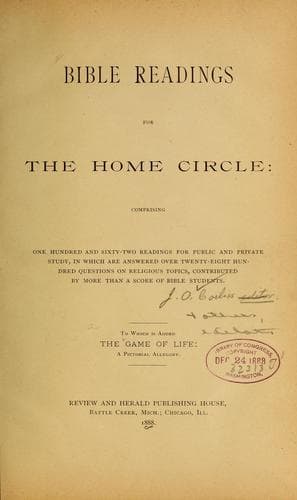
Bible -- Illustrations; Bible -- Indexes; Bible -- Study and teaching
“And His disciples asked Him, saying, Why then say the scribes that Elias
must first come? And Jesus answered and said unto them, Elias truly shall
first come, and restore all things. But I say unto you, That _Elias is
come already_, and they knew him not, but have done unto him whatsoever
they listed. Likewise shall also the Son of man suffer of them. Then the
disciples understood that He spake unto them of _John the Baptist_.” Matt.
17:10-13.
4. When John the Baptist was asked if he were Elijah, what did he say?
“And he said, _I am not_.” John 1:21.
5. Who did he say he was?
“He said, _I am the voice of one crying in the wilderness_. Make straight
the way of the Lord, as said the prophet Esaias.” Verse 23.
[Illustration.]
Translation Of Elijah. "Behold, there appeared a chariot of fire, ... and
Elijah went up by a whirlwind into heaven." 2 Kings 2:11.
6. In what sense does the angel Gabriel explain John the Baptist to be the
Elijah of Mal. 4:5?
“Many of the children of Israel shall he turn to the Lord their God. And
he shall go before Him [Christ] _in the spirit and power of Elias_, to
turn the hearts of the fathers to the children, and the disobedient to the
wisdom of the just; to make ready a people prepared for the Lord.” Luke
1:16, 17.
NOTE.—John went forth “_in the spirit and power of Elias_,” and,
in preparing a people for Christ’s first advent, did a work
similar to that done by Elijah the prophet in Israel centuries
before. See 1 Kings 17 and 18. In this sense, and in this sense
only, he was the Elijah of Mal. 4:5.
7. Near the close of the three and one-half years’ drought in Israel,
brought about as a judgment through the intercessions of Elijah (James
5:17) in consequence of Israel’s apostasy, what accusation did King Ahab
bring against Elijah?
“And it came to pass, when Ahab saw Elijah, that Ahab said unto him, _Art
thou he that troubleth Israel?_” 1 Kings 18:17.
8. What answer did Elijah make?
“And he answered, _I have not troubled Israel; but thou, and thy father’s
house, in that ye have forsaken the commandments of the Lord, and thou
hast followed Baalim_.” Verse 18.
NOTE.—Israel had departed from God, forsaken His commandments, and
gone off into idolatry. Jezebel, Ahab’s wicked and idolatrous
wife, had “cut off the prophets of the Lord” (verse 4), was
supporting hundreds of the prophets of Baal, and was seeking
Elijah to slay him. Elijah called for a famine on the land, and
said to Ahab, “As the Lord God of Israel liveth, before whom I
stand, there shall not be dew nor rain these years, but according
to my word.” 1 Kings 17:1. Elijah’s message was a call to
repentance and obedience to God’s commandments.
9. What plain proposition did he submit to all Israel?
Public-domain text, read in full here on John Shaqi.
Reviews
Reviews
No reviews yet
Be the first to share your thoughts on this work.
Elsewhere in the archive
Join the Discussion
Join the discussion
Sign in to leave a comment or review.
Sign InorCreate an account