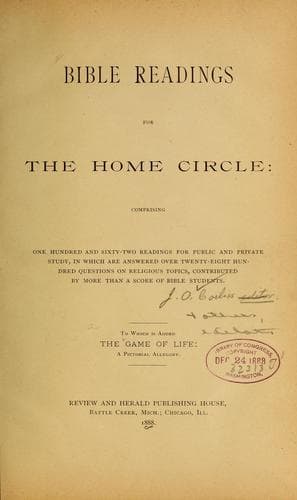
Bible -- Illustrations; Bible -- Indexes; Bible -- Study and teaching
“_These words the Lord spake_ unto all your assembly in the mount out of
the midst of the fire, of the cloud, and of the thick darkness, with a
great voice: _and He added no more_. And He wrote them in two tables of
stone, and delivered them unto me.” Deut. 5:22. “And the Lord said unto
Moses, Come up to Me into the mount, and be there: and I will give thee
_tables of stone_, and _a law_, and _commandments_ which I have written.”
Ex. 24:12.
10. Was the ceremonial law a complete law in itself?
“_The law_ of commandments _contained in ordinances_.” Eph. 2:15.
11. On what did God write the ten commandments?
“And He declared unto you His covenant, which He commanded you to perform,
even ten commandments; and _He wrote them upon two tables of stone_.”
Deut. 4:13.
12. In what were the laws or commandments respecting sacrifices and burnt
offerings written?
“And they removed the burnt offerings, that they might give according to
the divisions of the families of the people, to offer unto the Lord, as it
is written in _the book of Moses_.” 2 Chron. 35:12.
13. Where were the ten commandments placed?
“And he took and put the testimony _into the ark_, ... and put the
mercy-seat above upon the ark.” Ex. 40:20.
14. Where did Moses command the Levites to put the book of the law which
he had written?
“Moses commanded the Levites, which bare the ark of the covenant of the
Lord, saying, Take this book of the law, and _put it in the side of the
ark_ of the covenant of the Lord your God.” Deut. 31:25, 26.
15. What is the nature of the moral law?
“The law of the Lord is _perfect_, converting the soul.” Ps. 19:7. “For we
know that the law is _spiritual_.” Rom. 7:14.
16. Could the offerings commanded by the ceremonial law satisfy or make
perfect the conscience of the believer?
“Which was a figure for the time then present, in which were offered both
gifts and sacrifices, _that could not make him that did the service
perfect, as pertaining to the conscience_.” Heb. 9:9.
17. Until what time did the ceremonial law impose the service performed in
the worldly sanctuary?
“Which stood only in meats and drinks, and divers washings, and carnal
ordinances, _imposed on them until the time of reformation_.” Verse 10.
18. When was this time of reformation?
“But _Christ being come_ an high priest of good things to come, by a
greater and more perfect tabernacle, not made with hands, that is to say,
not of this building; neither by the blood of goats and calves, but by His
own blood He entered in once into the holy place, having obtained eternal
redemption for us.” Verses 11, 12.
19. How did Christ’s death affect the ceremonial law?
“_Blotting out the handwriting of ordinances_ that was against us, which
was contrary to us, and took it out of the way, nailing it to His cross.”
Col. 2:14. “Having _abolished_ in His flesh the enmity, even _the law of
commandments contained in ordinances_.” Eph. 2:15.
20. Why was the ceremonial law taken away?
Public-domain text, read in full here on John Shaqi.
Reviews
Reviews
No reviews yet
Be the first to share your thoughts on this work.
Elsewhere in the archive
Join the Discussion
Join the discussion
Sign in to leave a comment or review.
Sign InorCreate an account