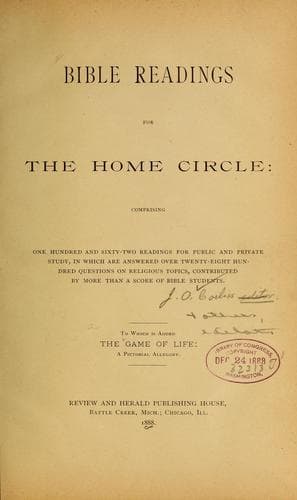
Bible -- Illustrations; Bible -- Indexes; Bible -- Study and teaching
NOTE.—The covenant of grace, with its provisions of pardon and
peace, dates from the foundation of the world.
19. To whom was this covenant-promise later renewed?
“And God said unto _Abraham_, ... Sarah thy wife shall bear thee a son
indeed; and thou shalt call his name Isaac: and I will establish My
covenant with him for an everlasting covenant, and with _his seed_ after
him.” “I will make thy seed to multiply as the stars of heaven, ... and in
_thy seed_ shall all the nations of the earth be blessed.” Gen. 17:15-19;
26:4.
20. Who was the seed here referred to?
“Now to Abraham and his seed were the promises made. He saith not, And to
seeds, as of many; but as of one, And to thy seed, _which is Christ_.”
Gal. 3:16.
[Illustration.]
Moses Breaking The Tables Of The Law. "Moses said unto the people, Ye have
sinned a great sin." Ex. 32:30.
21. What shows that the new or second covenant and the Abrahamic covenant
are virtually the same?
“And if ye be Christ’s, then are ye Abraham’s seed, and heirs according to
the promise.” Verse 29.
NOTE.—No one should allow himself to be confused by the terms
_first covenant_ and _second covenant_. While the covenant made at
Sinai is called the first covenant, it is by no means the first
covenant that God ever made with man. Long before this He made a
covenant with Abraham; He also made a covenant with Noah, and with
Adam. Neither must it be supposed that the first or old covenant
existed for a time as the _only_ covenant with mankind, and that
this must serve its purpose and pass away before any one could
share in the promised blessings of the second or new covenant. Had
this been the case, then during that time there would have been no
pardon for any one. What is called the new or second covenant
virtually existed before the covenant made at Sinai; for the
covenant with Abraham was confirmed in Christ (Gal. 3:17), and it
is only through Christ that there is any value to the new or
second covenant. There is no blessing that can be gained by virtue
of the new covenant that was not promised to Abraham. And we, with
whom the new covenant is made, can share the inheritance which it
promises only by being children of Abraham, and sharing in his
blessing. Gal. 3:7, 9. And since no one can have anything except
as a child of Abraham, it follows that there is nothing in what is
called the new or second covenant that was not in the covenant
made with Abraham. The second covenant existed in every essential
feature, except its ratification, long before the first, even from
the days of Adam. It is called second because its ratification
occurred after the covenant made and ratified at Sinai.
22. What is necessary where there is a covenant?
Public-domain text, read in full here on John Shaqi.
Reviews
Reviews
No reviews yet
Be the first to share your thoughts on this work.
Elsewhere in the archive
Join the Discussion
Join the discussion
Sign in to leave a comment or review.
Sign InorCreate an account