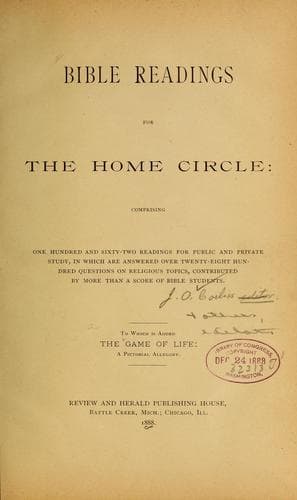
Bible -- Illustrations; Bible -- Indexes; Bible -- Study and teaching
NOTE.—It was not made for the Jews alone. The Jews derive their
name from Judah, one of the twelve sons of Jacob, from whom they
are descended. The Sabbath was made more than two thousand years
before there was a Jew. When Paul says, “Neither was the man
created for the woman; but the woman for the man” (1 Cor. 11:9),
we understand him to mean that marriage was ordained of God for
all men. So likewise with the Sabbath. It was made for the race.
6. What does the Sabbath commandment require?
“_Remember the Sabbath day, to keep it holy._ Six days shalt thou labor,
and do all thy work: but the seventh day is the Sabbath of the Lord thy
God: _in it thou shalt not do any work_, thou, nor thy son, nor thy
daughter, thy man servant, nor thy maid servant, nor thy cattle, nor thy
stranger that is within thy gates.” Ex. 20:8-10.
7. What reason is given in the commandment for keeping the Sabbath day
holy?
“_For in six days the Lord made heaven and earth, the sea, and all that in
them is, and rested the seventh day_: wherefore the Lord blessed the
Sabbath day, and hallowed it.” Verse 11.
NOTE.—The Sabbath is the memorial of creation, and the sign of
God’s creative power. Through the keeping of it God designed that
man should forever remember Him as the true and living God, the
Creator of all things.
8. Did God bless and sanctify the seventh day while He was resting upon
it, or when His rest on that day was past?
“And God blessed the seventh day, and sanctified it: _because that in it
He __HAD__ rested from all His work_ which God created and made.” Gen.
2:3.
NOTES.—God blessed and sanctified the seventh day then future,
answering to the day on which He had just rested. The acts of
blessing and sanctifying involve the idea of a future use of those
things which are blessed and sanctified. Past time cannot be used.
It is gone forever. The blessing and sanctification of the day,
therefore, must have related to the future—to all the future
seventh days.
In Joel 1:14 we read: “Sanctify [i.e., appoint] ye a fast, call a
solemn assembly, gather the elders and all the inhabitants of the
land into the house of the Lord.” Wherever used in the Bible, the
word sanctify means to appoint, to proclaim, or to set apart, as
in the margin of Joshua 20:7; 2 Kings 10:20, 21; Zeph. 1:7. So
when the Sabbath was sanctified, as the last act by which it was
made for man, an appointment, or proclamation, of the Sabbath was
given. See Ex. 19:23.
Public-domain text, read in full here on John Shaqi.
Reviews
Reviews
No reviews yet
Be the first to share your thoughts on this work.
Elsewhere in the archive
Join the Discussion
Join the discussion
Sign in to leave a comment or review.
Sign InorCreate an account