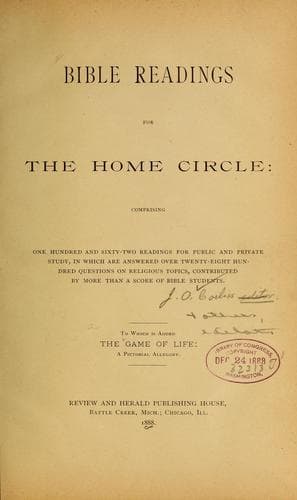
Bible -- Illustrations; Bible -- Indexes; Bible -- Study and teaching
NOTES.—“The earliest recognition of the observance of Sunday as a
legal duty is a constitution of Constantine in 321 A.D., enacting
that all courts of justice, inhabitants of towns, and workshops
were to be at rest on Sunday (_venerabili die Solis_), with an
exception in favor of those engaged in agricultural
labor.”—_Encyclopedia Britannica, ninth edition, article
__“__Sunday.__”_
“Constantine the Great made a law for the whole empire (321 A.D.)
that Sunday should be kept as a day of rest in all cities and
towns; but he allowed the country people to follow their
work.”—_Encyclopedia Americana, article __“__Sabbath.__”_
“Unquestionably the first law, either ecclesiastical or civil, by
which the Sabbatical observance of that day is known to have been
ordained, is the edict of Constantine, 321 A.D.”—_Chambers’s
Encyclopedia, article __“__Sabbath.__”_
18. What did Constantine’s law require?
“Let all the judges and town people, and the occupation of all trades rest
on the venerable day of the sun; but let those who are situated in the
country, freely and at full liberty, attend to the business of
agriculture; because it often happens that no other day is so fit for
sowing corn and planting vines; lest the critical moment being let slip,
men should lose the commodities granted by heaven.”—_Edict of March 7, 321
__A.D.__, Corpus Juris Civilis Cod., lib. 3, tit. 12, 3._
NOTE.—This edict, issued by Constantine, under whom the Christian
church and the Roman state were first united, in a manner supplied
the lack of a divine command for Sunday observance, and may be
considered the original Sunday law, and the model after which all
Sunday laws since then have been patterned. It was one of the
important steps in bringing about and establishing the change of
the Sabbath.
19. What testimony does Eusebius (270-338), a noted bishop of the church,
a flatterer of Constantine, and the reputed father of ecclesiastical
history, bear upon this subject?
“All things whatsoever that it was duty to do on the Sabbath, these _we_
have transferred to the Lord’s day.”—_“__Commentary on the Psalms,__”__
Cox’s __“__Sabbath Literature__”__ Vol. I, page 361._
NOTE.—The change of the Sabbath was the result of the combined
efforts of church and state, and it was centuries before it was
fully accomplished.
20. When and by what church council was the observance of the seventh day
forbidden, and Sunday observance enjoined?
“The seventh-day Sabbath was ... solemnized by Christ, the apostles, and
primitive Christians, till _the Laodicean Council_ did, in a manner, quite
abolish the observation of it. ... The Council of Laodicea [A.D. 364] ...
first settled the observation of the Lord’s day.”—_Prynne’s
__“__Dissertation on the Lord’s Day Sabbath,__”__ page 163._
Public-domain text, read in full here on John Shaqi.
Reviews
Reviews
No reviews yet
Be the first to share your thoughts on this work.
Elsewhere in the archive
Join the Discussion
Join the discussion
Sign in to leave a comment or review.
Sign InorCreate an account