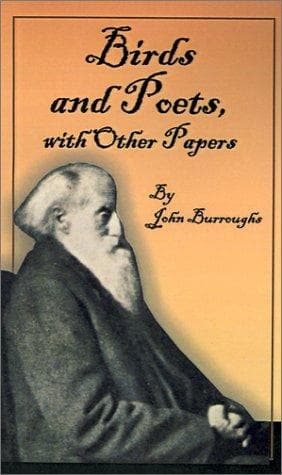
Birds and Poets : with Other PapersBurroughs, John
History
Birds and Poets : with Other Papers
Burroughs, John
American essays -- 19th century; Birds; Natural history -- Outdoor books; Nature
Before the man's complete acceptance and assimilation by America, he
may have to be first passed down through the minds of critics and
commentators, and given to the people with some of his rank new quality
taken off,--a quality like that which adheres to objects in the open
air, and makes them either forbidding or attractive, as one's mood is
healthful and robust or feeble and languid. The processes are silently
at work. Already seen from a distance, and from other atmospheres and
surroundings, he assumes magnitude and orbic coherence; for in curious
contrast to the general denial of Whitman in this country (though he
has more lovers and admirers here than is generally believed) stands
the reception accorded him in Europe. The poets there, almost without
exception, recognize his transcendent quality, the men of science his
thorough scientific basis, the republicans his inborn democracy, and all
his towering picturesque personality and modernness. Professor Clifford
says he is more thoroughly in harmony with the spirit and letter of
advanced scientism than any other living poet. Professor Tyrrell and Mr.
Symonds find him eminently Greek, in the sense in which to be natural
and "self-regulated by the law of perfect health" is to be Greek. The
French "Revue des Deux Mondes" pronounces his war poems the most vivid,
the most humanly passionate, and the most modern, of all the verse of
the nineteenth century. Freiligrath translated him into German, and
hailed him as the founder of a new democratic and modern order of
poetry, greater than the old. But I do not propose to go over the whole
list here; I only wish to indicate that the absorption is well commenced
abroad, and that probably her poet will at last reach America by way of
those far-off, roundabout channels. The old mother will first masticate
and moisten the food which is still too tough for her offspring.
When I first fell in with "Leaves of Grass," I was taken by isolated
passages scattered here and there through the poems; these I seized
upon, and gave myself no concern about the rest. Single lines in it
often went to the bottom of the questions that were vexing me. The
following, though less here than when encountered in the frame of mind
which the poet begets in you, curiously settled and stratified a certain
range of turbid, fluctuating inquiry:--
"There was never any more inception than there is now,--
Nor any more youth or age than there is now;
And will never be any more perfection than there is now,
Nor any more heaven or hell than there is now."
These lines, also, early had an attraction for me I could not define,
and were of great service:--
"Pleasantly and well-suited I walk,
Whither I walk I cannot define, but I know it is good,
The whole universe indicates that it is good,
The past and the present indicate that it is good."
In the following episode, too, there was to me something far deeper than
the words or the story:--
Public-domain text, read in full here on John Shaqi.
Reviews
Reviews
No reviews yet
Be the first to share your thoughts on this work.
Elsewhere in the archive
Join the Discussion
Join the discussion
Sign in to leave a comment or review.
Sign InorCreate an account