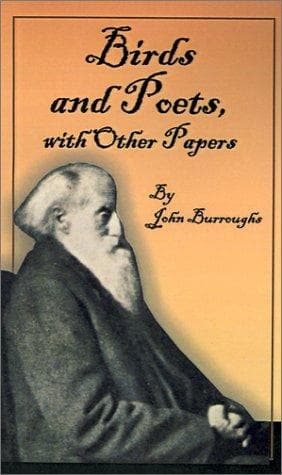
Birds and Poets : with Other PapersBurroughs, John
History
Birds and Poets : with Other Papers
Burroughs, John
American essays -- 19th century; Birds; Natural history -- Outdoor books; Nature
Ah, Time, you enchantress! what tricks you play with us! The old
is already proved,--the past and the distant hold nothing but the
beautiful.
Or let us take another view. Suppose Walt Whitman had never existed, and
some bold essayist, like Mr. Higginson or Matthew Arnold, had projected
him in abstract, outlined him on a scholarly ideal background,
formulated and put in harmless critical periods the principles of art
which he illustrates, and which are the inevitable logic of his
poems,--said essayist would have won great applause. "Yes, indeed, that
were a poet to cherish; fill those shoes and you have a god."
How different a critic's account of Shakespeare from Shakespeare
himself,--the difference between the hewn or sawed timber and the living
tree! A few years ago we had here a lecturer from over seas, who gave to
our well-dressed audiences the high, moral, and intellectual statement
of the poet Burns. It was very fine, and people were greatly pleased,
vastly more so, I fear, than they were with Burns himself. Indeed, I
could not help wondering how many of those appreciative listeners had
any original satisfaction in the Scotch poet at first hand, or would
have accepted him had he been their neighbor and fellow-citizen. But as
he filtered through the scholarly mind in trickling drops, oh, he was so
sweet!
Everybody stirred with satisfaction as the lecturer said: "When
literature becomes dozy, respectable, and goes in the smooth grooves
of fashion, and copies and copies again, something must be done; and
to give life to that dying literature a man must be found _not educated
under its influence."_ I applauded with the rest, for it was a bold
saying; but I could not help thinking how that theory, brought home
to ourselves and illustrated in a living example, would have sent that
nodding millinery and faultless tailory flying downstairs, as at an
alarm of fire.
One great service of Walt Whitman is that he exerts a tremendous
influence to bring the race up on this nether side,--to place the
emotional, the assimilative, the sympathetic, the spontaneous, intuitive
man, the man of the fluids and of the affections, flush with
the intellectual man. That we moderns have fallen behind here is
unquestionable, and we in this country more than the Old World peoples.
All the works of Whitman, prose and verse, are embosomed in a sea of
emotional humanity, and they float deeper than they show; there is far
more in what they necessitate and imply than in what they say.
It is not so much of fatty degeneration that we are in danger in
America, but of calcareous. The fluids, moral and physical, are
evaporating; surfaces are becoming encrusted, there is a deposit of
flint in the veins and arteries, outlines are abnormally sharp and hard,
nothing is held in solution, all is precipitated in well-defined ideas
and opinions.
Public-domain text, read in full here on John Shaqi.
Reviews
Reviews
No reviews yet
Be the first to share your thoughts on this work.
Elsewhere in the archive
Join the Discussion
Join the discussion
Sign in to leave a comment or review.
Sign InorCreate an account