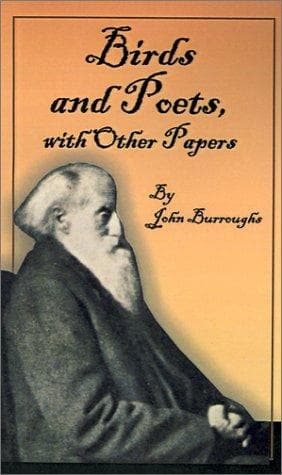
Birds and Poets : with Other PapersBurroughs, John
History
Birds and Poets : with Other Papers
Burroughs, John
American essays -- 19th century; Birds; Natural history -- Outdoor books; Nature
Again: Out of all the full-grown, first-class poems, no matter what
their plot or theme, emerges a sample of Man, each after its kind, its
period, its nationality, its antecedents. The vast and cumbrous Hindu
epics contribute their special types of both man and woman, impossible
except from far-off Asia and Asian antiquity. Out of Homer, after all
his gorgeous action and events, the distinct personal identity, the
heroic and warlike chieftain of Hellas only permanently remains. In the
same way, when the fire and fervor of Shakespeare's plots and passions
subside, the special feudal personality, as lord or gentleman, still
towers in undying vitality. Even the Sacred Writings themselves,
considered as the first great poems, leave on record, out of all the
rest, the portraiture of a characteristic Oriental Man. Far different
from these (and yet, as he says, "the same old countenance pensively
looking forth," and "the same red running blood"), "Leaves of Grass"
and "Two Rivulets" also bring their contribution; nay, behind every page
_that_ is the main purport,--to outline a New World Man and a New
World Woman, modern, complete, democratic, not only fully and nobly
intellectual and spiritual, but in the same measure physical, emotional,
and even fully and nobly carnal.
An acute person once said to me, "As I read and re-read these poems, I
more and more think their inevitable result in time must be to produce
'A race of splendid and savage _old men,_'
of course dominated by moral and spiritual laws, but with volcanoes of
force always alive beneath the surface."
And still again: One of the questions to be put to any poem assuming a
first-class importance among us--and I especially invite this inquiry
toward "Leaves of Grass"--is, How far is this work consistent with, and
the outcome of, that something which secures to the race ascendency,
empire, and perpetuity? There is in every dominant people a germ, a
quality, an expansive force, that, no matter how it is overlaid, gives
them their push and their hold upon existence,--writes their history
upon the earth, and stamps their imprint upon the age. To what extent is
your masterpiece the standard-bearer of this quality,--helping the race
to victory? helping me to be more myself than I otherwise would?
III
Not the least of my poet's successes is in his thorough assimilation of
the modern sciences, transmuting them into strong poetic nutriment, and
in the extent to which all his main poems are grounded in the deepest
principles of modern philosophical inquiry.
Public-domain text, read in full here on John Shaqi.
Reviews
Reviews
No reviews yet
Be the first to share your thoughts on this work.
Elsewhere in the archive
Join the Discussion
Join the discussion
Sign in to leave a comment or review.
Sign InorCreate an account