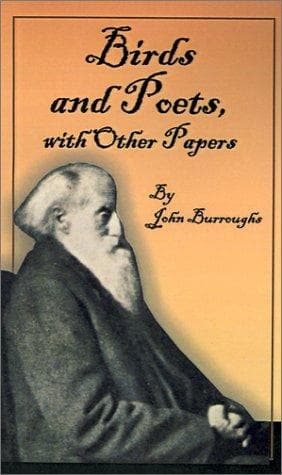
Birds and Poets : with Other PapersBurroughs, John
History
Birds and Poets : with Other Papers
Burroughs, John
American essays -- 19th century; Birds; Natural history -- Outdoor books; Nature
It has been said that the object of poetry and the higher forms of
literature is to escape from the tyranny of the real into the freedom of
the ideal; but what is the ideal unless ballasted and weighted with the
real? All these poems have a lofty ideal background; the great laws
and harmonies stretch unerringly above them, and give their vista
and perspective. It is because Whitman's ideal is clothed with rank
materiality, as the soul is clothed with the carnal body, that his poems
beget such warmth and desire in the mind, and are the reservoirs of so
much power. No one can feel more than I how absolutely necessary it is
that the facts of nature and experience be born again in the heart
of the bard, and receive the baptism of the true fire before they be
counted poetical; and I have no trouble on this score with the author
of "Leaves of Grass." He never fails to ascend into spiritual meanings.
Indeed, the spirituality of Walt Whitman is the chief fact after all,
and dominates every page he has written.
Observe that this singer and artist makes no _direct_ attempt to be
poetical, any more than he does to be melodious or rhythmical. He
approaches these qualities and results as it were from beneath, and
always indirectly; they are drawn to him, not he to them; and if they
appear absent from his page at first, it is because we have been looking
for them in the customary places on the outside, where he never puts
them, and have not yet penetrated the interiors. As many of the fowls
hide their eggs by a sort of intuitive prudery and secretiveness,
Whitman always half hides, or more than half hides, his thought, his
glow, his magnetism, his most golden and orbic treasures.
Finally, as those men and women respect and love Walt Whitman best who
have known him longest and closest personally, the same rule will apply
to "Leaves of Grass" and the later volume, "Two Rivulets." It is indeed
neither the first surface reading of those books, nor perhaps even the
second or third, that will any more than prepare the student for the
full assimilation of the poems. Like Nature, and like the Sciences, they
suggest endless suites of chambers opening and expanding more and more
and continually.
INDEX
[Transcribist's note: Index has been shortened to names
of authors and to birds, with scientific names.]
Aeschylus
Akers, Elizabeth.
Apuleius.
Audubon, John Jaines.
Bacon, Francis.
Benton, Myron.
Bible.
Bittern, American (_Botaurus lentiginosus_).
Bjoernson, Bjoernstjerne.
Blackbird, cow, or cowbird (_Molothrus ater_).
Blackbird, European.
Bluebird (_Sialia sialis_).
Bobolink (_Dolichonyx oryzivorus_).
Bryant, William Cullen.
Buchanan, Robert.
Bunting, snow, or snowflake (_Passerina nivalis_).
Burke, Edmund.
Burns, Robert.
Byron, Lord.
Public-domain text, read in full here on John Shaqi.
Reviews
Reviews
No reviews yet
Be the first to share your thoughts on this work.
Elsewhere in the archive
Join the Discussion
Join the discussion
Sign in to leave a comment or review.
Sign InorCreate an account