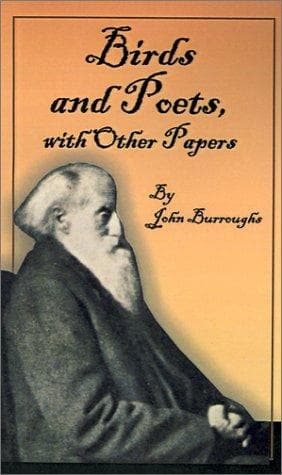
Birds and Poets : with Other PapersBurroughs, John
History
Birds and Poets : with Other Papers
Burroughs, John
American essays -- 19th century; Birds; Natural history -- Outdoor books; Nature
A prominent April bird, that one does not have to go to the woods or
away from his own door to see and hear, is the hardy and ever-welcome
meadowlark. What a twang there is about this bird, and what vigor! It
smacks of the soil. It is the winged embodiment of the spirit of our
spring meadows. What emphasis in its _"z-d-t, z-d-t"_ and what character
in its long, piercing note! Its straight, tapering, sharp beak is
typical of its voice. Its note goes like a shaft from a crossbow; it
is a little too sharp and piercing when near at hand, but, heard in the
proper perspective, it is eminently melodious and pleasing. It is one
of the major notes of the fields at this season. In fact, it easily
dominates all others. _"Spring o' the year! spring o' the year!"_ it
says, with a long-drawn breath, a little plaintive, but not complaining
or melancholy. At times it indulges in something much more intricate and
lark-like while hovering on the wing in midair, but a song is beyond the
compass of its instrument, and the attempt usually ends in a breakdown.
A clear, sweet, strong, high-keyed note, uttered from some knoll or
rock, or stake in the fence, is its proper vocal performance. It has the
build and walk and flight of the quail and the grouse. It gets up before
you in much the same manner, and falls an easy prey to the crack shot.
Its yellow breast, surmounted by a black crescent, it need not be
ashamed to turn to the morning sun, while its coat of mottled gray is
in perfect keeping with the stubble amid which it walks. The two lateral
white quills in its tail seem strictly in character. These quills spring
from a dash of scorn and defiance in the bird's make-up. By the aid
of these, it can almost emit a flash as it struts about the fields and
jerks out its sharp notes. They give a rayed, a definite and piquant
expression to its movements. This bird is not properly a lark, but a
starling, say the ornithologists, though it is lark-like in its habits,
being a walker and entirely a ground-bird. Its color also allies it to
the true lark. I believe there is no bird in the English or European
fields that answers to this hardy pedestrian of our meadows. He is a
true American, and his note one of our characteristic April sounds.
Another marked April note, proceeding sometimes from the meadows, but
more frequently from the rough pastures and borders of the woods, is
the call of the high-hole, or golden-shafted woodpecker. It is quite as
strong as that of the meadowlark, but not so long-drawn and piercing.
It is a succession of short notes rapidly uttered, as if the bird said
_"if-if-if-if-if-if-if."_ The notes of the ordinary downy and hairy
woodpeckers suggest, in some way, the sound of a steel punch; but
that of the high-hole is much softer, and strikes on the ear with real
springtime melody. The high-hole is not so much a wood-pecker as he is
a ground-pecker. He subsists largely on ants and crickets, and does not
appear till they are to be found.
Public-domain text, read in full here on John Shaqi.
Reviews
Reviews
No reviews yet
Be the first to share your thoughts on this work.
Elsewhere in the archive
Join the Discussion
Join the discussion
Sign in to leave a comment or review.
Sign InorCreate an account