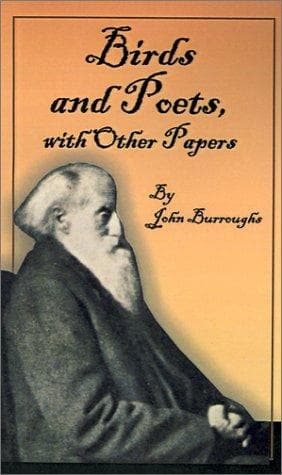
Birds and Poets : with Other PapersBurroughs, John
History
Birds and Poets : with Other Papers
Burroughs, John
American essays -- 19th century; Birds; Natural history -- Outdoor books; Nature
This is the bird that Thomas Jefferson wrote to Wilson about, greatly
exciting the latter's curiosity. Wilson was just then upon the threshold
of his career as an ornithologist, and had made a drawing of the Canada
jay which he sent to the President. It was a new bird, and in reply
Jefferson called his attention to a "curious bird" which was everywhere
to be heard, but scarcely ever to be seen. He had for twenty years
interested the young sportsmen of his neighborhood to shoot one for him,
but without success. "It is in all the forests, from spring to fall,"
he says in his letter, "and never but on the tops of the tallest trees,
from which it perpetually serenades us with some of the sweetest notes,
and as clear as those of the nightingale. I have followed it for miles,
without ever but once getting a good view of it. It is of the size
and make of the mockingbird, lightly thrush-colored on the back, and a
grayish white on the breast and belly. Mr. Randolph, my son-in-law, was
in possession of one which had been shot by a neighbor," etc. Randolph
pronounced it a flycatcher, which was a good way wide of the mark.
Jefferson must have seen only the female, after all his tramp, from his
description of the color; but he was doubtless following his own great
thoughts more than the bird, else he would have had an earlier view. The
bird was not a new one, but was well known then as the ground-robin. The
President put Wilson on the wrong scent by his erroneous description,
and it was a long time before the latter got at the truth of the case.
But Jefferson's letter is a good sample of those which specialists often
receive from intelligent persons who have seen or heard something in
their line very curious or entirely new, and who set the man of science
agog by a description of the supposed novelty,--a description that
generally fits the facts of the case about as well as your coat fits the
chair-back. Strange and curious things in the air, and in the water, and
in the earth beneath, are seen every day except by those who are looking
for them, namely, the naturalists. When Wilson or Audubon gets his eye
on the unknown bird, the illusion vanishes, and your phenomenon turns
out to be one of the commonplaces of the fields or woods.
Public-domain text, read in full here on John Shaqi.
Reviews
Reviews
No reviews yet
Be the first to share your thoughts on this work.
Join the Discussion
Join the discussion
Sign in to leave a comment or review.
Sign InorCreate an account