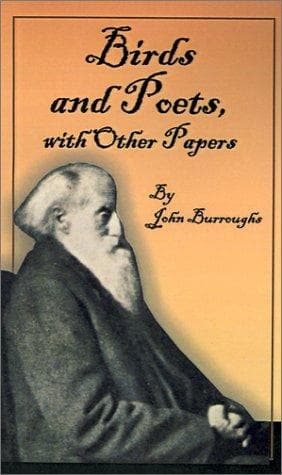
Birds and Poets : with Other PapersBurroughs, John
History
Birds and Poets : with Other Papers
Burroughs, John
American essays -- 19th century; Birds; Natural history -- Outdoor books; Nature
Of prose poets who have the charm of the springtime upon them, the best
recent example I know of is Bjoernson, the Norwegian romancist. What
especially makes his books spring-like is their freshness and sweet good
faith. There is also a reticence and an unwrought suggestiveness about
them that is like the promise of buds and early flowers. Of Turgenieff,
the Russian, much the same thing might be said. His stories are simple
and elementary, and have none of the elaborate hair-splitting and forced
hot-house character of the current English or American novel. They
spring from stronger, more healthful and manly conditions, and have a
force in them that is like a rising, incoming tide.
VI OUR RURAL DIVINITY
I wonder that Wilson Flagg did not include the cow among his
"Picturesque Animals," for that is where she belongs. She has not the
classic beauty of the horse, but in picture-making qualities she is far
ahead of him. Her shaggy, loose-jointed body; her irregular, sketchy
outlines, like those of the landscape,--the hollows and ridges, the
slopes and prominences; her tossing horns, her bushy tail, tier swinging
gait, her tranquil, ruminating habits,--all tend to make her an object
upon which the artist eye loves to dwell. The artists are forever
putting her into pictures, too. In rural landscape scenes she is
an important feature. Behold her grazing in the pastures and on the
hillsides, or along banks of streams, or ruminating under wide-spreading
trees, or standing belly-deep in the creek or pond, or lying upon the
smooth places in the quiet summer afternoon, the day's grazing done,
and waiting to be summoned home to be milked; and again in the twilight
lying upon the level summit of the hill, or where the sward is thickest
and softest; or in winter a herd of them filing along toward the spring
to drink, or being "foddered" from the stack in the field upon the new
snow,--surely the cow is a picturesque animal, and all her goings and
comings are pleasant to behold.
I looked into Hamerton's clever book on the domestic animals also,
expecting to find my divinity duly celebrated, but he passes her by and
contemplates the bovine qualities only as they appear in the ox and the
bull.
Neither have the poets made much of the cow, but have rather dwelt
upon the steer, or the ox yoked to the plow. I recall this touch from
Emerson:--
"The heifer that lows in the upland farm,
Far heard, lows not thine ear to charm."
But the ear is charmed, nevertheless, especially if it be not too near,
and the air be still and dense, or hollow, as the farmer says. And
again, if it be springtime and she task that powerful bellows of hers
to its utmost capacity, how round the sound is, and how far it goes over
the hills!
Public-domain text, read in full here on John Shaqi.
Reviews
Reviews
No reviews yet
Be the first to share your thoughts on this work.
Elsewhere in the archive
Join the Discussion
Join the discussion
Sign in to leave a comment or review.
Sign InorCreate an account