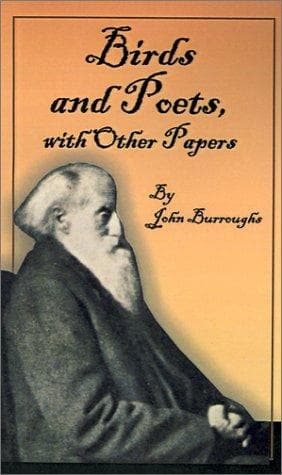
Birds and Poets : with Other PapersBurroughs, John
History
Birds and Poets : with Other Papers
Burroughs, John
American essays -- 19th century; Birds; Natural history -- Outdoor books; Nature
What depths can a man sound but his own, or what heights explore? "We
carry within us," says Sir Thomas Browne, "the wonders we seek without
us."
Indeed, there is a strict moral or ethical dependence of the capacity
to conceive or to project great things upon the capacity to be or to
do them. It is as true as any law of hydraulics or of statics, that the
workmanship of a man can never rise above the level of his character.
He can never adequately say or do anything greater than he himself is.
There is no such thing, for instance, as deep insight into the mystery
of Creation, without integrity and simplicity of character.
In the highest mental results and conditions the whole being
sympathizes. The perception of a certain range of truth, such as is
indicated by Plato, Hegel, Swedenborg, and which is very far from
what is called "religious" or "moral," I should regard as the best
testimonial that could be offered of a man's probity and essential
nobility of soul. Is it possible to imagine a fickle, inconstant, or a
sly, vain, mean person reading and appreciating Emerson? Think of the
real men of science, the great geologists and astronomers, one opening
up time, the other space! Shall mere intellectual acumen be accredited
with these immense results? What noble pride, self-reliance, and
continuity of character underlie Newton's deductions!
Only those books are for the making of men into which a man has gone in
the making. Mere professional skill and sleight of hand, of themselves,
are to be apprized as lightly in letters as in war or in government,
or in any kind of leadership. Strong native qualities only avail in the
long run; and the more these dominate over the artificial endowments,
sloughing or dropping the latter in the final result, the more we are
refreshed and enlarged. Who has not, at some period of his life, been
captivated by the rhetoric and fine style of nearly all the popular
authors of a certain sort, but at last waked up to discover that behind
these brilliant names was no strong, loving man, but only a refined
taste, a fertile invention, or a special talent of one kind or another.
Think of the lather of the modern novel, and the fashion-plate men and
women that figure in it! What noble person has Dickens sketched, or
has any novelist since Scott? The utter poverty of almost every current
novelist, in any grand universal human traits in his own character, is
shown in nothing more clearly than in the _kind_ of interest the reader
takes in his books. We are led along solely by the ingenuity of the
plot, and a silly desire to see how the affair came out. What must be
the effect, long continued, of this class of jugglers working upon the
sympathies and the imagination of a nation of gestating women?
Public-domain text, read in full here on John Shaqi.
Reviews
Reviews
No reviews yet
Be the first to share your thoughts on this work.
Elsewhere in the archive
Join the Discussion
Join the discussion
Sign in to leave a comment or review.
Sign InorCreate an account