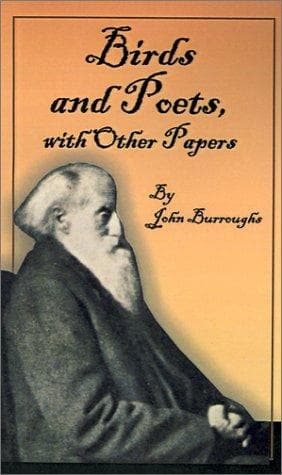
Birds and Poets : with Other PapersBurroughs, John
History
Birds and Poets : with Other Papers
Burroughs, John
American essays -- 19th century; Birds; Natural history -- Outdoor books; Nature
It is very likely true that our most native and original characters do
not yet take to literature. It is, perhaps, too early in the day. Iron
and lime have to pass through the vegetable before they can reach the
higher organization of the animal, and maybe this Western nerve and
heartiness will yet emerge on the intellectual plane. Let us hope that
it will indeed be Western nerve and heartiness when it gets there, and
not Eastern wit and epigram!
In Abraham Lincoln we had a character of very marked and lofty type, the
most suggestive study or sketch of the future American man that has
yet appeared in our history. How broad, unconventional, and humane!
How democratic! how adhesive! No fine arabesque carvings, but strong,
unhewn, native traits, and deep lines of care, toil, and human
sympathy. Lincoln's Gettysburg speech is one of the most genuine
and characteristic utterances in our annals. It has the true antique
simplicity and impressiveness. It came straight from the man, and is as
sure an index of character as the living voice, or the physiognomy, or
the personal presence. Indeed, it may be said of Mr. Lincoln's entire
course while at the head of the nation, that no President, since the
first, ever in his public acts allowed the man so fully to appear, or
showed so little disposition to retreat behind the featureless political
mask which seems to adhere to the idea of gubernatorial dignity.
It would be hardly fair to cite Everett's speech on the same occasion
as a specimen of the opposite style, wherein ornate scholarship and the
pride of talents dominate. Yet a stern critic would be obliged to
say that, as an author, Everett allowed, for the most part, only
the expurgated, complimenting, drawing-room man to speak; and that,
considering the need of America to be kept virile and broad at all
hazards, his contribution, both as man and writer, falls immeasurably
short of Abraham Lincoln's.
What a noble specimen of its kind, and how free from any verbal tricks
or admixture of literary sauce, is Thoreau's "Maine Woods"! And what a
marked specimen of the opposite style is a certain other book I could
mention in which these wild and grand scenes serve but as a medium to
advertise the author's fund of classic lore!
Can there be any doubt about the traits and outward signs of a noble
character, and is not the style of an author the manners of his soul?
Public-domain text, read in full here on John Shaqi.
Reviews
Reviews
No reviews yet
Be the first to share your thoughts on this work.
Elsewhere in the archive
Join the Discussion
Join the discussion
Sign in to leave a comment or review.
Sign InorCreate an account