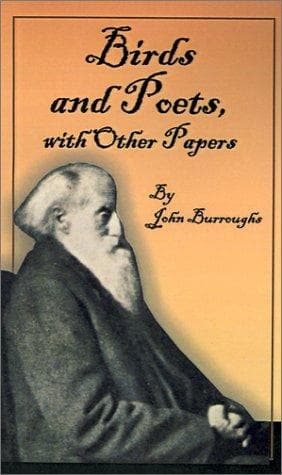
Birds and Poets : with Other PapersBurroughs, John
History
Birds and Poets : with Other Papers
Burroughs, John
American essays -- 19th century; Birds; Natural history -- Outdoor books; Nature
The Roman was perhaps the first to separate beauty from use, and to
pursue it as ornament merely. He built his grand edifice,--its piers,
its vaults, its walls of brick and concrete,--and then gave it a
marble envelope copied from the Greek architecture. The latter could be
stripped away, as in many cases it was by the hand of time, and leave
the essentials of the structure nearly complete. Not so with the Greek:
he did not seek the beautiful, he was beauty; his building had no
ornament, it was all structure; in its beauty was the flower of
necessity, the charm of inborn fitness and proportion. In other words,
"his art was structure refined into beautiful forms, not beautiful forms
superimposed upon structure," as with the Roman. And it is in Greek
mythology, is it not, that Beauty is represented as riding upon the back
of a lion? as she assuredly always does in their poetry and art,--rides
upon power, or terror, or savage fate; not only rides upon, but
is wedded and incorporated with it; hence the athletic desire and
refreshment her coming imparts.
This is the invariable order of nature. Beauty without a rank material
basis enfeebles. The world is not thus made; man is not thus begotten
and nourished.
It comes to me there is something implied or understood when we
look upon a beautiful object, that has quite as much to do with the
impression made upon the mind as anything in the object itself; perhaps
more. There is somehow an immense and undefined background of vast and
unconscionable energy, as of earthquakes, and ocean storms, and cleft
mountains, across which things of beauty play, and to which they
constantly defer; and when this background is wanting, as it is in much
current poetry, beauty sickens and dies, or at most has only a feeble
existence.
Nature does nothing merely for beauty; beauty follows as the inevitable
result; and the final impression of health and finish which her works
make upon the mind is owing as much to those things which are not
technically called beautiful as to those which are. The former give
identity to the latter. The one is to the other what substance is to
form, or bone to flesh. The beauty of nature includes all that is called
beautiful, as its flower; and all that is not called beautiful, as its
stalk and roots.
Public-domain text, read in full here on John Shaqi.
Reviews
Reviews
No reviews yet
Be the first to share your thoughts on this work.
Elsewhere in the archive
Join the Discussion
Join the discussion
Sign in to leave a comment or review.
Sign InorCreate an account