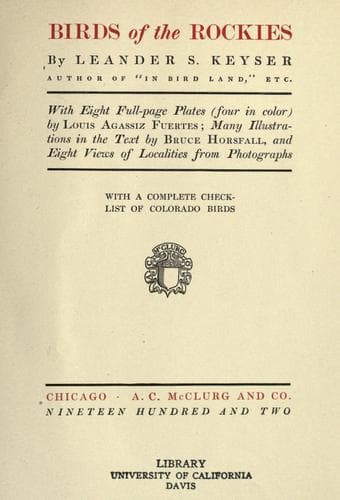
Birds of the RockiesKeyser, Leander S. (Leander Sylvester)
History
Birds of the Rockies
Keyser, Leander S. (Leander Sylvester)
Birds; Birds -- Colorado
Then one of them, no doubt the male, darted from a pine branch obliquely
into the air, and mounted up and up and up, in a series of graceful
leaps, until he was a mere speck against the blue dome, gyrating to and
fro in zigzag lines, or wheeling in graceful circles, his song dribbling
faintly down to me at frequent intervals. A thing of buoyancy and grace,
more angel than bird, that wonderful winged creature floated about in
the cerulean sky; how long I do not know, whether five minutes, or ten,
or twenty, but so long that at last I flung myself upon my back and
watched him until my eyes ached. He kept his wings in constant motion,
the white portions making them appear filmy as the sun shone upon them.
Suddenly he bent his head, partly folded his wings, and swept down
almost vertically like an arrow, alighting safe somewhere among the
pines. I have seen other birds performing aerial evolutions accompanied
with song, but have never known one to continue so long on the wing.
What was this wonderful bird? It was Townsend's solitaire (_Myadestes
townsendii_)--a bird which is peculiar to the West, especially to the
Rocky Mountains, and which belongs to the same family as the thrushes
and bluebirds. No literature in my possession contains any reference to
this bird's astonishing aerial flight and song, and I cannot help
wondering whether other bird-students have witnessed the interesting
exploit.
Subsequently I found a pair of solitaires on the plains near Arvada. The
male was a powerful singer. Many of his outbursts were worthy of the
mocking-bird, to some of whose runs they bore a close resemblance. He
sang almost incessantly during the half day I spent in the neighborhood,
my presence seeming to inspire him to the most prodigious lyrical
efforts of which he was master. Sometimes he would sit on the top of a
bush or a fence-post, but his favorite perches were several ridges of
sand and gravel. His flight was the picture of grace, and he had a habit
of lifting his wings, now one, now the other, and often both, after the
manner of the mocking-bird on a chimney-top. He and his mate did not
utter a chirp, but made a great to-do by singing, and finally I
discovered that all the fuss was not about a nest, but about a hulking
youngster that had outgrown his kilts and looked very like a brown
thrasher. Neither of this second pair of solitaires performed any
evolutions in the upper air; nor did another pair that I found far up a
snow-clad mountain near Breckenridge, on the other side of the
Continental Divide.
Public-domain text, read in full here on John Shaqi.
Reviews
Reviews
No reviews yet
Be the first to share your thoughts on this work.
Elsewhere in the archive
Join the Discussion
Join the discussion
Sign in to leave a comment or review.
Sign InorCreate an account