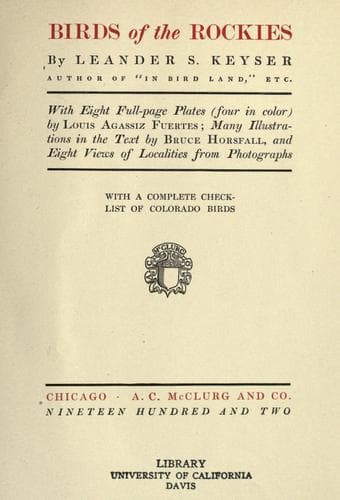
Birds of the RockiesKeyser, Leander S. (Leander Sylvester)
History
Birds of the Rockies
Keyser, Leander S. (Leander Sylvester)
Birds; Birds -- Colorado
There are other jays in the Rockies that deserve attention. The Rocky
Mountain jay--_Perisoneus canadensis capitalis_--is a bird of the higher
altitudes, remaining near the timber-line all the year round, braving
the most rigorous weather and the fiercest mountain storms during the
winter. Although not an attractive species, his hardiness invests him
with not a little interest. One can imagine him seeking a covert in the
dense pineries when a storm sweeps down from the bald, snow-mantled
summits, squawking his disapproval of the ferocity of old Boreas, and
yet able to resist his most violent onsets.
[Illustration: _The Rocky Mountain Jay_
"_Seeking a covert in the dense pineries when a storm sweeps down from
the mountains_"]
Early in April, at an altitude of from eight thousand to eleven thousand
five hundred feet, these jays begin to breed. At that height this is
long before the snow ceases to fall; indeed, on the twentieth of June,
while making the descent from Pike's Peak, I was caught in a snowfall
that gave the ground quite a frosty aspect for a few minutes. One can
readily fancy, therefore, that the nests of these birds are often
surrounded with snow, and that the bantlings may get their first view
of the world in the swirl of a snow-squall. The nests are built in pine
bushes and trees at various distances from the ground. Of all the
hurly-burlies ever heard, that which these birds are able to make when
you go near their nests, or discover them, bears off the palm, their
voices being as raucous as a buzz-saw, fairly setting your teeth on
edge.
Those of us who live in the East are so accustomed to the adjective
"blue" in connection with the jay that we are surprised to find that _P.
c. capitalis_ wears no blue whatever, but dons a sombre suit of leaden
gray, somewhat relieved by the blackish shade of the wings and tail,
with their silvery or frosted lustre. He is certainly not an attractive
bird, either in dress or in form, for he appears very "thick-headed" and
lumpish, as if he scarcely knew enough to seek shelter in a time of
storm; but, of course, a bird that contrives to coax a livelihood out of
such unpromising surroundings must possess a fine degree of
intelligence, and, therefore, cannot be so much of a dullard as his
appearance would indicate.
Public-domain text, read in full here on John Shaqi.
Reviews
Reviews
No reviews yet
Be the first to share your thoughts on this work.
Elsewhere in the archive
Join the Discussion
Join the discussion
Sign in to leave a comment or review.
Sign InorCreate an account