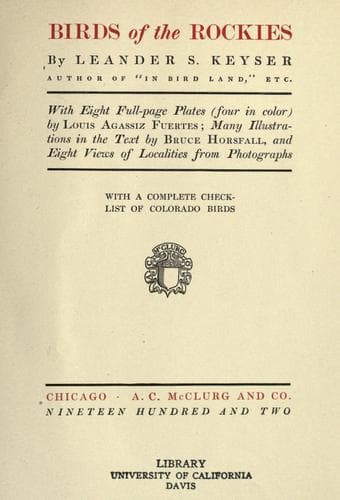
Birds of the RockiesKeyser, Leander S. (Leander Sylvester)
History
Birds of the Rockies
Keyser, Leander S. (Leander Sylvester)
Birds; Birds -- Colorado
He has some interesting ways, too, as will be seen from the following
quotation from a Colorado writer: "White-headed, grave, and sedate, he
seems a very paragon of propriety, and if you appear to be a suitable
personage, he will be apt to give you a bit of advice. Becoming
confidential, he sputters out a lot of nonsense which causes you to
think him a veritable 'whiskey Jack.' Yet, whenever he is disposed, a
more bland, mind-your-own-business appearing bird will be hard to find;
as will also many small articles around camp after one of his visits,
for his whimsical brain has a great fancy for anything which may be
valuable to you, but perfectly useless to himself." This habit of
purloining has won him the title of "camp robber" among the people of
the Rocky Mountains.
Woodhouse's jay, also peculiar to the Rocky Mountain region, is mostly
to be found along the base of the foothills and the lower wooded
mountains. While he may be called a "blue" jay, having more of that
color in his plumage than even the long-crested, he belongs to the
_Aphelcoma_ group--that is, he is without a crest.
Every observer of eastern feathered folk is familiar with our "little
boy blue," the indigo-bird, whose song is such a rollicking and saucy
air, making you feel as if the little lyrist were chaffing you. In
Colorado, however, you do not meet this animated chunk of blue, but
another little bird that belongs to the same group, called the "painted
finches," although their plumes are not painted any more than those of
other species. This bird is the lazuli bunting. He wears a great deal of
blue, but it is azure, and not indigo, covering the head, neck, most of
the upper parts, and the lining of the wings; and, as if to give
variety to the bird's attire, the nape and back are prettily shaded with
brown, and the wings and tail with black. But his plumage is still more
variegated, for he bears a conspicuous white spot on the greater
wing-coverts, and his breast is daintily tinted with chestnut-brown,
abruptly cut off from the blue of the throat, while the remaining under
parts are snowy white. From this description it will be seen that he is
quite unlike the indigo-bird, which has no brown or white in his
cerulean attire. Handsome as Master Indigo is, the lazuli finch, with
his sextet of hues, is a more showily dressed bird; in fact, a lyric in
colors.
Public-domain text, read in full here on John Shaqi.
Reviews
Reviews
No reviews yet
Be the first to share your thoughts on this work.
Elsewhere in the archive
Join the Discussion
Join the discussion
Sign in to leave a comment or review.
Sign InorCreate an account