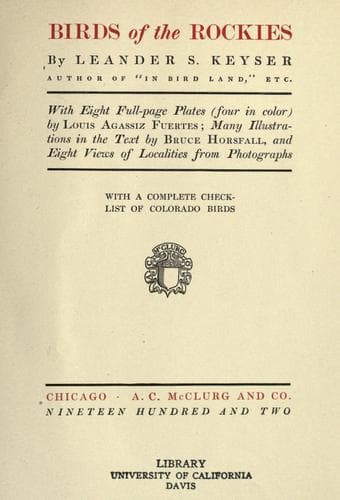
Birds of the RockiesKeyser, Leander S. (Leander Sylvester)
History
Birds of the Rockies
Keyser, Leander S. (Leander Sylvester)
Birds; Birds -- Colorado
The lazuli finch does not venture very high into the mountains, seldom
reaching an altitude of more than seven thousand feet. He is a lover of
the plains, the foothills, and the lower ranges of the mountains. In
this respect he differs from some other little birds, which seek a
summer home in the higher regions. On the southern slope of Pike's Peak,
a little below the timber-line, I found a dainty little bird which was a
stranger to me. It was Audubon's warbler. At first sight I decided that
he must be the myrtle warbler, but was compelled to change my conclusion
when I got a glimpse of his throat, which was golden yellow, whereas the
throat of _Dendroica coronata_ is pure white. Then, too, the myrtle
warbler is only a migrant in Colorado, passing farther north to breed.
Audubon's, it must be said, has extremely rich habiliments, his upper
parts being bluish-ash, streaked with black, his belly and under
tail-coverts white, and his breast in high feather, black, prettily
skirted with gray or invaded with white from below; but his yellow
spots, set like gleaming gold in various parts of his plumage,
constitute his most marked embellishment, being found on the crown,
rump, throat, and each side of the chest.
On my first excursion to some meadows and wooded low-grounds south of
Colorado Springs, while listening to a concert given by western
meadow-larks, my attention was attracted to a large, black bird circling
about the fields and then alighting on a fence-post. My first thought
was: "It is only a crow blackbird." But on second thought I decided that
the crow blackbird did not soar and circle about in this manner. At all
events, there seemed to be something slightly peculiar about this bird's
behavior, so I went nearer to inspect him, when he left his perch on the
post, flapped around over the meadow, and finally flew to a large,
partially decayed cottonwood tree in a pasture field. If I could believe
my eyes, he clung to the upright stems of the branches after the style
of a woodpecker! That was queer indeed--a woodpecker that looked
precisely like a blackbird! Such a featherland oddity was certainly
foreign to any of my calculations; for, it must be remembered, this was
prior to my making acquaintance with Williamson's sapsucker.
Closer inspection proved that this bird was actually hitching up and
down the branches of the tree in the regular woodpecker fashion.
Presently he slipped into a hole in a large limb, and the loud, eager
chirping of young birds was heard. It was not long before his mate
appeared, entered the cavity, and fed the clamorous brood. The birds
proved to be Lewis's woodpeckers, another distinctly western type. My
field-glass soon clearly brought out their peculiar markings.
Public-domain text, read in full here on John Shaqi.
Reviews
Reviews
No reviews yet
Be the first to share your thoughts on this work.
Elsewhere in the archive
Join the Discussion
Join the discussion
Sign in to leave a comment or review.
Sign InorCreate an account