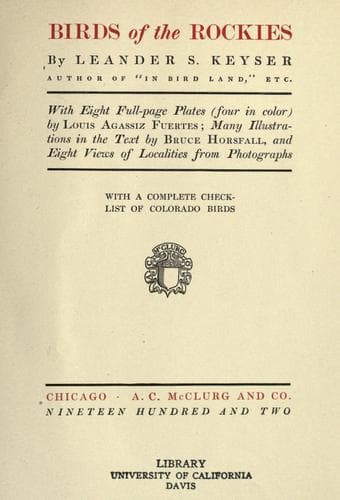
Birds of the RockiesKeyser, Leander S. (Leander Sylvester)
History
Birds of the Rockies
Keyser, Leander S. (Leander Sylvester)
Birds; Birds -- Colorado
The natural home of _Cinclus mexicanus_ is the Rocky Mountains, to which
he is restricted, not being known anywhere else on this continent. He is
the only member of the dipper family in North America. There is one
species in South America, and another in Europe. He loves the mountain
stream, with its dashing rapids and cascades. Indeed, he will erect his
oven-like cottage nowhere else, and it must be a fall and not a mere
ripple or rapid. Then from this point as a centre--or, rather, the
middle point of a wavering line--he forages up and down the babbling,
meandering brook, feeding chiefly, if not wholly, on water insects.
Strange to say, he never leaves the streams, never makes excursions to
the country roundabout, never flies over a mountain ridge or divide to
reach another valley, but simply pursues the winding streams with a
fidelity that deserves praise for its very singleness of purpose. No
"landlubber" he. It is said by one writer that the dipper has never been
known to alight on a tree, preferring a rock or a piece of driftwood
beside the babbling stream; yet he has the digits and claws of the
passeres, among which he is placed systematically. He is indeed an
anomaly, though a very engaging one. Should he wish to go to another
cañon, he will simply follow the devious stream he is on to its junction
with the stream of the other valley; then up the second defile. His
flight is exceedingly swift. His song is a loud, clear, cheerful strain,
the very quintessence of gladness as it mingles with the roar of the
cataracts.
Farther up Ute Pass I found another nest, which was placed right back
of a cascade, so that the birds had to dash through a curtain of spray
to reach their cot. They also were feeding their young, and I could see
them standing on a rock beneath the shelf, tilting their bodies and
scanning me narrowly before diving into the cleft where the nest was
hidden. This nest, being placed back of the falls, could not be reached.
In Bear Creek cañon I discovered another inaccessible nest, which was
placed in a fissure at the very foot of the falls and only an inch or
two above the agitated waters. There must have been a cavity running
back into the rock, else the nest would have been kept in a soggy
condition all the time.
Public-domain text, read in full here on John Shaqi.
Reviews
Reviews
No reviews yet
Be the first to share your thoughts on this work.
Elsewhere in the archive
Join the Discussion
Join the discussion
Sign in to leave a comment or review.
Sign InorCreate an account