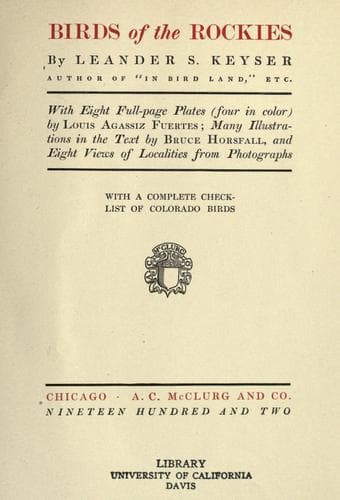
Birds of the RockiesKeyser, Leander S. (Leander Sylvester)
History
Birds of the Rockies
Keyser, Leander S. (Leander Sylvester)
Birds; Birds -- Colorado
In winter, when the rushing mountain streams are flowing with the sludge
of the half-melted snow, so that he cannot see the bottom, where most of
his delicacies lie, he betakes himself to the quieter stretches of the
rivers, or to the mill ponds or mountain lakes, where he finds clearer
and smoother water, although a little deeper than he usually selects.
Such weather does not find him at the end of his resources; no, indeed!
Having betaken himself to a lake, he does not at once plunge into its
depths after the manner of a duck, but finding a perch on a snag or a
fallen pine, he sits there a moment, and then, flying out thirty or
forty yards, "he alights with a dainty glint on the surface, swims
about, looks down, finally makes up his mind, and disappears with a
sharp stroke of his wings." So says Mr. John Muir, who continues: "After
feeding for two or three minutes he suddenly reappears, showers the
water from his wings with one vigorous shake, and rises abruptly into
the air as if pushed up from beneath, comes back to his perch, sings a
few minutes, and goes out to dive again; thus coming and going, singing
and diving, at the same place for hours."
The depths to which the cinclid dives for the food on the bottom is
often from fifteen to twenty feet. When he selects a river instead of a
lake for his winter bathing, its waters, like those of the shallower
streams, may also contain a large quantity of sludge, thus rendering
them opaque even to the sharp little eyes of the dipper. Then what does
he do? He has a very natural and cunning way of solving this problem; he
simply seeks a deep portion of the river and dives through the turbid
water to the clear water beneath, where he can plainly see the "goodies"
on the bottom.
It must not be thought that this little bird is mute amid all the watery
tumult of his mountain home, for he is a rare vocalist, his song
mingling with the ripple and gurgle and roar of the streams that he
haunts. Nor does he sing only in the springtime, but all the year round,
on stormy days as well as fair. During Indian summer, when the streams
are small, and silence broods over many a mountain solitude, the song of
the ousel falls to its lowest ebb; but when winter comes and the streams
are converted into rolling torrents, he resumes his vocal efforts, which
reach their height in early summer. Thus it would seem that the bird's
mood is the gayest when his favorite stream is dashing at its noisiest
and most rapid pace down the steep mountain defiles. The clamor of the
stream often drowns the song of the bird, the movement of his mandibles
being seen when not a sound from his music-box can be heard. There must
be a feeling of fellowship between the bird and the stream he loves so
well.
[Illustration: "_No snowstorm can discourage him_"]
Public-domain text, read in full here on John Shaqi.
Reviews
Reviews
No reviews yet
Be the first to share your thoughts on this work.
Elsewhere in the archive
Join the Discussion
Join the discussion
Sign in to leave a comment or review.
Sign InorCreate an account