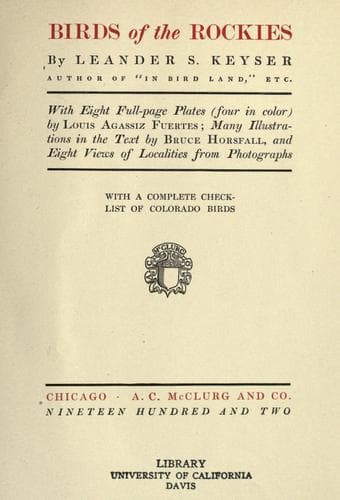
Birds of the RockiesKeyser, Leander S. (Leander Sylvester)
History
Birds of the Rockies
Keyser, Leander S. (Leander Sylvester)
Birds; Birds -- Colorado
He is certainly an attractive species, and I wish we could offer
sufficient inducements to bring him east. A bird like him is a boon and
an ornament to the streets and parks of any city that he graces with
his presence and enlivens with his songs. No selfish recluse is he; no,
indeed! In no dark gulch or wilderness, far from human neighborhood,
does he sulkily take up his abode, but prefers the companionship of man
to the solitudes of nature, declaring in all his conduct that he likes
to be where there are "folks." In this respect he bears likeness to the
English sparrow; but let it be remembered that there the analogy stops.
Even his chirruping is musical as he flies overhead, or makes his
_caveat_ from a tree or a telegraph wire against your ill-bred
espionage. He and his plainly clad little spouse build a neat cottage
for their bairns about the houses, but do not clog the spouting and make
themselves a nuisance otherwise, as is the habit of their English
cousins.
This finch is a minstrel, not of the first class, still one that merits
a high place among the minor songsters; and, withal, he is generous with
his music. You might call him a kind of urban Arion, for there is real
melody in his little score. As he is an early riser, his matin
voluntaries often mingled with my half-waking dreams in the morning at
dawn's peeping, and I loved to hear it too well to be angry for being
aroused at an unseasonable hour. The song is quite a complicated
performance at its best, considerably prolonged and varied, running up
and down the chromatic scale with a swing and gallop, and delivered
with great rapidity, as if the lyrist were in a hurry to have done, so
that he could get at something else.
In my rambles he was found not only in the cities of the plains (Denver,
Colorado Springs, and Pueblo), but also in many of the mountain towns
and villages visited, Leadville, over ten thousand feet skyward, being,
I believe, one of the exceptions, while Silver Plume and Graymont were
others. He does not fancy altitudes, I take it, much over eight thousand
feet. In the villages of Red Cliff and Glenwood, both beyond the
continental divide, he was the same sprightly citizen, making himself
very much at home.
Much as this finch cherishes the society of man, he is quite wary and
suspicious, and does not fancy being watched. As long as you go on your
way without seeming to notice him, he also goes his way, coming into
plain sight and chirping and singing; but just stop to watch him with
your binocular, and see how quickly he will take alarm, dart away, and
ensconce himself behind a clump of foliage, uttering a protest which
seems to say, "Why doesn't that old fellow go about his own business?"
If in some way the American house-finch could be persuaded to come east,
and the English sparrow could be given papers of extradition, the
exchange would be a relief and a benefit to the whole country.
Public-domain text, read in full here on John Shaqi.
Reviews
Reviews
No reviews yet
Be the first to share your thoughts on this work.
Elsewhere in the archive
Join the Discussion
Join the discussion
Sign in to leave a comment or review.
Sign InorCreate an account