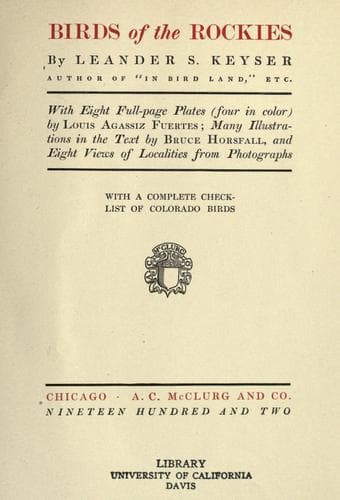
Birds of the RockiesKeyser, Leander S. (Leander Sylvester)
History
Birds of the Rockies
Keyser, Leander S. (Leander Sylvester)
Birds; Birds -- Colorado
After a couple of hours of hard climbing, we reached the summit, from
which we were afforded a magnificent view of the foothills, the mesas,
and the stretching plains below us, while above us to the west hills
rose on hills until they culminated in mighty snow-capped peaks and
ridges. It must not be supposed, because the snow-mantled summits in the
west loomed far above our present station, that this mountain which we
had ascended was a comparatively insignificant affair. The fact is, it
was of huge bulk and great height measured from its base in the cañon;
almost as much of a mountain, in itself considered, as Gray's Peak. It
must be borne in mind that the snowy peaks were from thirty to forty
miles away, and that there is a gradual ascent the entire distance to
the upper valleys and gorges which creep about the bases of the loftiest
peaks and ridges. A mountain rising from the foothills may be almost as
bulky and high and precipitous as one of the alpine peaks covered with
eternal snow. Its actual altitude above sea-level may be less by many
thousand feet, while its height from the surrounding cañons and valleys
may be almost, if not quite, as great. The alpine peaks have the
advantage of majesty of situation, because the general level of the
country from which they rise is very high. There we stood at a sort of
outdoor halfway house between the plains and the towering ridges, and I
can only say that the view was superb.
There were certain kinds of birds which had brought their household gods
to the mountain's crest. Lewis's woodpeckers ambled about over the
summit and rocky ridges, catching insects on the wing, as is their wont.
Some distance below the summit a pair of them had a nest in a dead pine
snag, from the orifice of which one was seen to issue. A mother hawk was
feeding a couple of youngsters on the snarly branch of a dead pine.
Almost on the summit a western nighthawk sprang up from my feet. On the
bare ground, without the faintest sign of a nest, lay her two speckled
eggs, which she had been brooding. She swept around above the summit in
immense zigzag spirals while I examined her roofless dwelling-place. It
was interesting to one bird-lover, at least, to know that the nighthawk
breeds in such places. Like their eastern congeners, the western
nighthawks are fond of "booming." At intervals a magpie would swing
across the cañon, looking from side to side, the impersonation of
cautious shyness. A few rods below the crest a couple of rock wrens were
flitting about some large rocks, creeping in and out among the crevices
like gray mice, and at length one of them slyly fed a well-fledged
youngster. This proves that these birds, like many of their congeners,
are partial to a commanding lookout for a nesting site. These were the
only occupants of the mountain's brow at the time of our visit, although
in one of the hollows below us the spurred and green-tailed towhees were
Public-domain text, read in full here on John Shaqi.
Reviews
Reviews
No reviews yet
Be the first to share your thoughts on this work.
Elsewhere in the archive
Join the Discussion
Join the discussion
Sign in to leave a comment or review.
Sign InorCreate an account