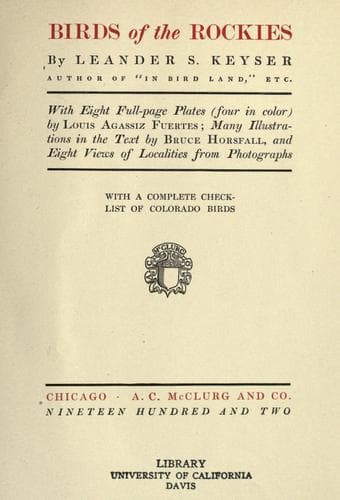
Birds of the RockiesKeyser, Leander S. (Leander Sylvester)
History
Birds of the Rockies
Keyser, Leander S. (Leander Sylvester)
Birds; Birds -- Colorado
The white-crowns in the Georgetown valley seemed to be excessively shy,
and their singing was a little too reserved to be thoroughly enjoyable,
for which reason I am disposed to think that mating and nesting had not
yet begun, or I should have found evidences of it, as their grassy cots
on the ground and in the bushes are readily discovered. Other birds that
were seen in this afternoon's ramble were Wilson's and Audubon's
warblers, the spotted sandpiper, and that past-master in the art of
whining, the killdeer. Another warbler's trill was heard in the thicket,
but I was unable to identify the singer that evening, for he kept
himself conscientiously hidden in the tanglewood. A few days later it
turned out to be one of the most beautiful feathered midgets of the
Rockies, Macgillivray's warbler, which was seen in a number of places,
usually on bushy slopes. He and his mate often set up a great to-do by
chirping and flitting about, and I spent hours in trying to find their
nests, but with no other result than to wear out my patience and rubber
boots. I can recall no other Colorado bird, either large or small,
except the mountain jay, that made so much ado about nothing, so far as
I could discover. But I love them still, on account of the beauty of
their plumage and the gentle rhythm of their trills.
The next morning, chilly as the weather was--and it was cold enough to
make one shiver even in bed--the western robins opened the day's concert
with a splendid voluntary, waking me out of my slumbers and forcing me
out of doors for an early walk. No one but a systematic ornithologist
would be able to mark the difference between the eastern and western
types of robins, for their manners, habits, and minstrelsy are alike,
and their markings, too, so far as ordinary observation goes. The
carolling of the two varieties is similar, so far as I could
discern--the same cherry ringing melody, their voices having a like
propensity to break into falsetto, becoming a veritable squeak,
especially early in the season before their throat-harps are well tuned.
With his powerful muscles and wide stretch of wing the robin is
admirably adapted to the life of a mountaineer. You find him from the
plains to the timber-line, sometimes even in the deepest cañons and on
the most precipitous mountain sides, always the same busy, noisy, cheery
body. One day I saw a robin dart like a meteor from the top of a high
ridge over the cliffs to the valley below, where he alighted on a
cultivated field almost as lightly as a flake of snow. He--probably she
(what a trouble these pronouns are, anyway!)--gathered a mouthful of
worms for his nestlings, then dashed up to the top of the ridge again,
which he did, not by flying out into the air, but by keeping close up to
the steep, cliffy wall, striking a rock here and twig there with his
agile feet to help him in rising. The swiftness of the robin's movements
about the gorges, abysses, and precipices of the mountains often
Public-domain text, read in full here on John Shaqi.
Reviews
Reviews
No reviews yet
Be the first to share your thoughts on this work.
Elsewhere in the archive
Join the Discussion
Join the discussion
Sign in to leave a comment or review.
Sign InorCreate an account